The Nephilim are among the most mysterious beings mentioned in the Hebrew Bible.
They appear explicitly in only two passages – Genesis 6:4 and Numbers 13:33 – yet those brief references generated an enormous interpretive tradition involving:
- Giants
- Rebellious heavenly beings
- The Watchers
- Forbidden knowledge
- The Flood
- Demons; and
questions about whether non-human beings could physically interact with humanity.
Genesis places the Nephilim in the strange period when the “sons of God” took women from among the “daughters of humankind.” Numbers later associates the Nephilim with the Anakim and overwhelming physical size.
But Genesis never pauses to tell us exactly who the Nephilim were.
Later Jewish literature from the Second Temple period – especially 1 Enoch – provides a far more elaborate interpretation. In the Book of the Watchers, heavenly beings descend to earth, take human wives, and father enormous and violent offspring.
The Book of Jubilees preserves a closely related tradition, while fragments of the Book of Giants discovered among the Dead Sea Scrolls demonstrate how extensively these stories developed within ancient Judaism.
So, who were the Nephilim?
The most historically influential supernatural interpretation connects them with the giant offspring produced by unions between rebellious heavenly beings and human women.
But an important distinction must be made from the beginning:
Genesis 6:4 itself is brief and grammatically difficult. Later texts such as 1 Enoch and Jubilees make the offspring interpretation far more explicit than Genesis does.
That distinction is essential if we want to separate:
- What the biblical text explicitly says,
- What ancient Jewish interpreters believed it meant,
- What later Christian traditions taught; and
- What modern writers speculate about today.
Nephilim: Key Facts
Before examining the evidence in detail, several conclusions can be stated with reasonable confidence.
- The word Nephilim appears explicitly in Genesis 6:4 and Numbers 13:33.
- Genesis does not call the Nephilim “fallen angels.”
- The exact etymology of the Hebrew word Nephilim remains disputed.
- The ancient Greek Septuagint translated Nephilim with gigantes, contributing to the ancient association with giants.
- Numbers 13 associates the Nephilim with the Anakim and extraordinary physical stature.
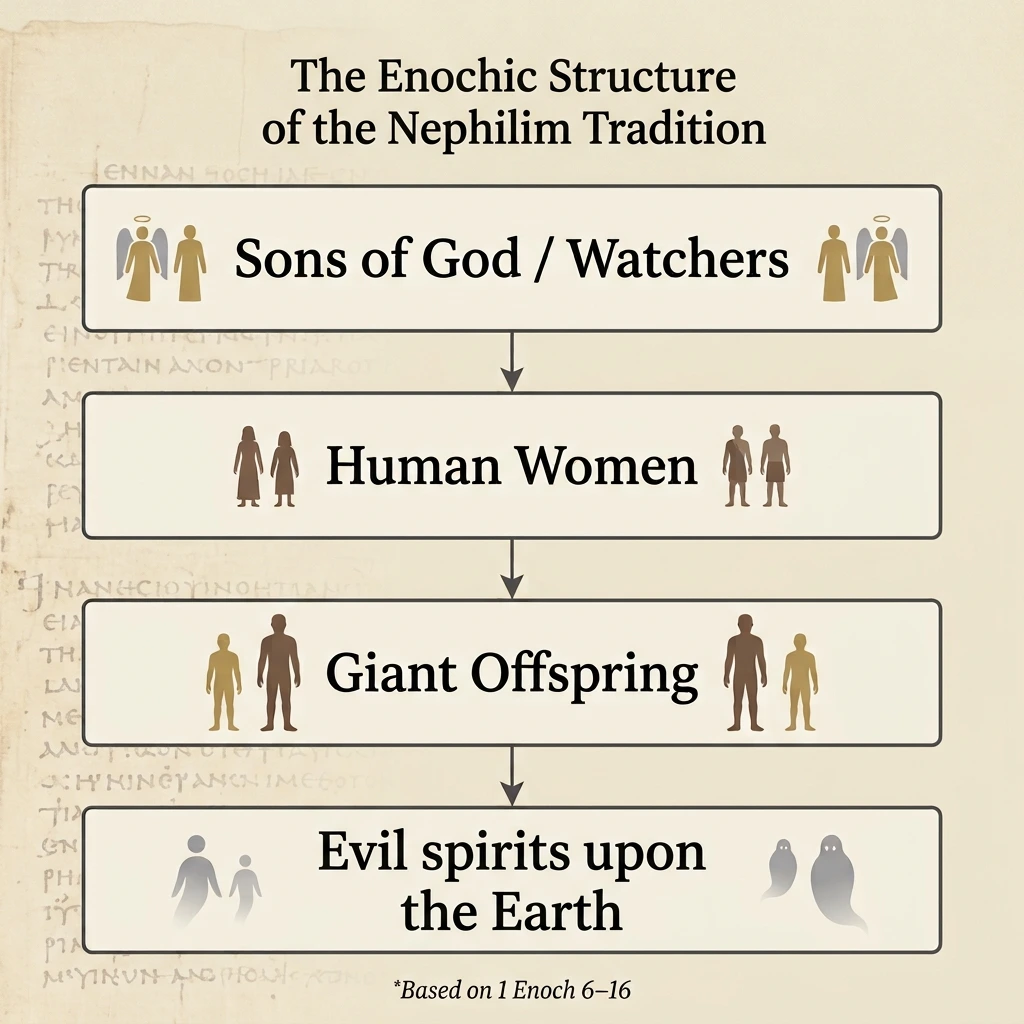
- 1 Enoch 6–16 interprets the Genesis 6 episode as a rebellion involving heavenly Watchers, human women, and giant offspring.
- In Enochian literature, the Watchers and their offspring are not the same beings.
- Jubilees likewise describes angels taking human wives and fathering giant offspring.
- Several prominent early Christian writers retained forms of the supernatural interpretation.
- The idea that the Nephilim were extraterrestrial “aliens” is a modern comparison, not something the ancient texts themselves say.
Where Are the Nephilim Mentioned in the Bible?
The term occurs explicitly in only two places.
Genesis 6:1–4
Genesis 6:1-4 opens by describing humanity multiplying across the earth.
The text then introduces a mysterious group called the “sons of God” (Benei Elohim) who see the daughters of humankind, find them desirable, and take wives from among them.
Genesis 6:4 then introduces the Nephilim:
“The Nephilim were on the earth in those days—and also afterward…”
The Hebrew expression is:
הַנְּפִלִים — ha-nephilim
The verse continues by referring to the sons of God going in to the daughters of humankind, children being born, and the appearance of the gibborim – the “mighty ones,” “warriors,” or “men of renown.”
This is one of the most important interpretive problems in Genesis.
Are the Nephilim themselves the children born from the unions between the sons of God and human women?
A traditional supernatural reading says yes.
Indeed, ancient Jewish literature such as 1 Enoch interprets the story exactly this way.
But Genesis is not as explicit as 1 Enoch.
The Hebrew verse first states that the Nephilim were present “in those days,” and then refers to the sons of God entering into unions with women and children being born.
Scholars therefore continue to debate whether Genesis 6:4 grammatically identifies the Nephilim directly as the offspring or merely places them in the same period and narrative.
That gives us two statements that should not be confused.
Genesis certainly places the Nephilim within the same episode as the unions between the sons of God and human women.
But:
Whether Genesis itself states with absolute grammatical clarity that the Nephilim are those offspring remains debated.
Later Second Temple literature removes much of this ambiguity.
Numbers 13:33
The second explicit reference appears during the Israelite spies’ report after scouting Canaan.
The spies say they saw the Nephilim and connect them with the sons of Anak, or Anakim. They describe themselves as seeming like grasshoppers in comparison.
That passage establishes an important biblical association:
Nephilim → Anakim → extraordinary size and intimidation.
We should still be careful.
Numbers 13:33 occurs within the spies’ fearful report, and the narrative itself portrays that report negatively. Some interpreters therefore regard the language as exaggerated.
Nevertheless, the passage clearly demonstrates that the Nephilim tradition had become, at least in some contexts, associated with beings of unusual physical stature.
The broader conquest traditions reinforce this giant motif through references to the Anakim, Rephaim, Emim, and other formidable peoples.
What Does the Word “Nephilim” Mean?
One of the most repeated claims online is:
Nephilim means “fallen ones.”
That interpretation may be correct.
But it should not be presented as an undisputed lexical fact.
The Hebrew is:
נְפִילִים — nephilim
The word is frequently connected with the Hebrew root:
נפל — n-p-l — “to fall”
This has led to translations and interpretations such as:
- “Fallen ones,”
- “Those who fall,”
- Or even “those who cause others to fall.”
The problem is that Hebrew etymology is not always as simple as identifying a familiar-looking root.
Scholars and reference works have long noted that the derivation of Nephilim is uncertain.
It is therefore more accurate to say:
“Fallen ones” is a traditional and plausible interpretation of the name Nephilim, but it is not an uncontested dictionary definition.
That matters because theological conclusions are often built on the assumed meaning.
Someone may reason:
Nephilim means fallen ones. Therefore the Nephilim are fallen angels.
But that argument contains two separate problems.
First, the etymology is disputed.
Second, even if Nephilim were related to the concept of falling, that would not by itself prove that the Nephilim are the heavenly beings who rebelled.
In the Enochian tradition, they are not.
Why Did the Septuagint Translate Nephilim as Gigantes?
The ancient Greek translation of the Hebrew Scriptures – the Septuagint – renders Nephilim using the Greek term:
γίγαντες — gigantes
This is the source behind many English translations and traditions that simply call the Nephilim “giants.”
But this deserves more nuance than it normally receives.
The Greek word gigantes certainly became associated with beings of enormous stature, but within Greek mythology the Gigantes were not simply unusually tall humans.
They belonged to a mythological world involving extraordinary beings, divine conflict, and cosmic rebellion.
That does not mean the Jewish translators of the Septuagint intended to import the entirety of Greek mythology into Genesis.
It does show, however, that their chosen term carried considerably more conceptual weight than the English word “tall.”
The Septuagint therefore provides evidence of an ancient interpretive association between the Nephilim and extraordinary, superhuman figures.
When combined with Numbers 13 and later Second Temple literature, the connection between the Nephilim and giants becomes extremely old.
Does Nephilim Simply Mean “Giants”?
No.
The Hebrew term *Nephilim* is not simply the normal Hebrew word for “giants.” However, the association between the Nephilim and giant beings is ancient and substantial.
Three strands of evidence support that conclusion.
First, Numbers 13:33 associates them with the Anakim and extraordinary size. Second, the Septuagint uses gigantes. Third, Second Temple Jewish literature explicitly develops the offspring associated with Genesis 6 as gigantic beings (and more).
So the careful conclusion is:
Nephilim does not simply mean “giants,” but ancient interpreters very clearly, and often, understood the Nephilim tradition in connection with giants.
Were the Nephilim Giants?
Ancient Jewish tradition strongly associates the Nephilim with giants – but it does not necessarily portray all of these beings as one uniform race of identical size or appearance.
Genesis itself gives no measurement for the Nephilim. It never tells us that they were a particular number of cubits tall.
Numbers 13:33, however, clearly associates the Nephilim with the Anakim and extraordinary physical stature: the Israelite spies describe themselves as appearing like grasshoppers by comparison.
Whatever degree of rhetorical exaggeration may be present in the spies’ report, the passage demonstrates that the Nephilim tradition had become connected with beings of intimidating size.
Second Temple literature develops that association much further, but also introduces something often overlooked in popular discussions. Namely, different classes of giant or hybrid offspring.
Jubilees Describes Different Classes
In Jubilees 7, Noah recounts the corruption that preceded the Flood. The Watchers take human wives and produce offspring, but the text does not describe the resulting beings as though they were all identical.
Jubilees 7:22 says that they produced sons and that “they were all unlike.” The passage then distinguishes what appear to be three categories or generations of beings: the Giants, the Naphil, and the Elioud/Eljo, who turn violently against one another and eventually against humanity.
James C. VanderKam, in his major commentary on Jubilees, notes that the passage distinguishes three kinds of beings, different from one another: giants, naphil, and elyo. He further observes that this classification corresponds to a similar threefold tradition in the Enochic Animal Apocalypse.
The exact relationship among these categories is textually complicated, and the surviving manuscript traditions do not allow us to reconstruct every biological or genealogical detail with certainty. But the larger point is significant:
The ancient tradition did not necessarily envision a single, homogeneous population called “the Nephilim.” It could distinguish multiple types or generations of giant offspring.
1 Enoch Also Preserves a Threefold Tradition
A related idea appears in another portion of 1 Enoch known as the Animal Apocalypse.
In 1 Enoch 86:4, the rebellious heavenly beings are represented symbolically as fallen stars who mate with cattle representing human beings. Their offspring are depicted not as one species, but as elephants, camels, and asses.
These are symbolic animals, not a claim that literal elephants and camels were born from the Watchers. The imagery represents different classes of the monstrous offspring associated with the Genesis 6 tradition.
Scholars have noted that the three animal designations appear to preserve wordplays based on the underlying Aramaic terminology for different giant groups. The same three categories recur later in the Animal Apocalypse as the violent offspring are judged.
This means that both Jubilees and Enochic literature preserve a tradition in which the offspring of the Watchers were differentiated rather than uniform.
Ancient Traditions Also Preserve Different Heights
Nor do the surviving traditions require us to imagine every giant as hundreds of feet tall.
The famous enormous measurements found in some manuscripts and translations of 1 Enoch 7 are themselves textually problematic. The manuscript tradition varies, which makes precise reconstructions of the original measurement uncertain.
More significantly, Jubilees 29 describes the Rephaim of Gilead as giants whose heights ranged from ten cubits down through nine, eight, and seven cubits.
Whatever exact modern measurement one assigns to an ancient cubit, the point is clear: this tradition explicitly imagines giant figures of different heights.
This is important because popular depictions often flatten every ancient giant tradition into a single caricature – hundreds of feet tall, identical in form, and belonging to one biological category.
The ancient sources are more complicated.
Later Jewish Tradition Expanded the Classifications Further
Later rabbinic literature continued to preserve multiple designations for the ancient giants.
Genesis Rabbah 26:7, for example, states that the giants were known by seven names:
- Nephilim
- Emim
- Rephaim
- Gibborim
- Zamzummim
- Anakim
- Avim
The midrash then interprets several of those names individually.
We should be cautious about treating this later list as a scientific taxonomy or assuming that every name necessarily represents a biologically distinct “species.” Some are biblical ethnonyms, some may overlap, and the rabbinic text is explaining ancient traditions many centuries after Genesis.
Nevertheless, it demonstrates that Jewish interpreters did not always reduce the giant traditions to one undifferentiated group.
So Were the Nephilim Giants?
The best answer is:
The Nephilim were strongly associated with giant beings in ancient Jewish interpretation, but the wider tradition is more diverse than the popular formula “the Nephilim were one race of enormous giants” suggests.
The evidence instead preserves:
- Giant figures of varying heights,
- Multiple named giant peoples in the Hebrew Bible,
- Three differentiated classes of Watcher offspring in Jubilees,
- A parallel threefold symbolic classification in 1 Enoch’s Animal Apocalypse; and
- Later Jewish traditions that group several different ancient peoples under the broader category of giants.
So when 1 Enoch describes enormous offspring, that should not automatically be taken to mean that every being associated with the Nephilim tradition was imagined as identical in size, morphology, or lineage.
The ancient evidence points toward a considerably more complex giant tradition.
Who Were the “Sons of God” in Genesis 6?
This is the question behind the Nephilim question. If we want to understand Genesis 6, we must ask who the sons of God were.
Three interpretations dominate the discussion.
1. Heavenly Beings
Under the supernatural interpretation, the sons of God are members of the heavenly realm.
Supporters point particularly to the Hebrew expression **bene ha-elohim** and related terminology in texts such as:
- Job 1:6
- Job 2:1
- Job 38:7
In those passages, the “sons of God” clearly belong to the divine or heavenly assembly. This interpretation also fits the way Genesis 6 was understood in the Book of the Watchers.
There, the heavenly beings are explicitly angels or Watchers who descend and take human wives.
2. The Descendants of Seth
The Sethite interpretation identifies the sons of God as descendants of Seth.
Under this view, Genesis 6 describes intermarriage between the supposedly godly line of Seth and women associated with an ungodly human lineage, often connected with Cain.
This interpretation eventually became highly influential in Christianity. But, it is not the earliest surviving interpretation we possess.
The Sethite reading became increasingly important during the Christian patristic period and eventually displaced the angelic interpretation in many theological traditions.
3. Human Kings or Rulers
Another theory identifies the sons of God with human kings, rulers, aristocrats, or warrior elites. Ancient Near Eastern kings sometimes used divine-son language, and powerful rulers were capable of taking women according to their desires.
This view understands Genesis 6 primarily as a critique of violent royal abuse and tyranny. Each interpretation deserves a full treatment.
For present purposes, one historical fact is especially important:
The interpretation of the sons of God as heavenly beings is extremely ancient.
It was not invented by modern UFO researchers, prophecy teachers, or twentieth-century fundamentalists.
It is deeply embedded in surviving Second Temple Jewish literature.
Were the Nephilim the Children of the Sons of God?
Under the ancient Watchers interpretation:
Yes.
But again, Genesis and later interpretation should be separated.
Genesis places together:
- The sons of God,
- Human women,
- Children being born,
- The Nephilim; and
- The mighty men of old.
Many readers therefore understand the Nephilim as the resulting offspring. But Genesis 6:4 does not explain the relationship with the level of detail that later texts provide. When we reach 1 Enoch, the ambiguity largely disappears:
- The heavenly Watchers descend.
- They take women.
- The women become pregnant; and
- Giant offspring are born.
Likewise, Jubilees 5 describes angels taking wives and fathering sons who become giants.
So while we must remain precise about what Genesis itself explicitly states, we can say something historically significant with confidence:
The interpretation that Genesis 6 describes heavenly beings fathering giant offspring was already established within Judaism centuries before the Christian era.
What Does 1 Enoch Say About the Nephilim?
The portion of 1 Enoch commonly called the Book of the Watchers occupies chapters 1–36. Its central Watchers narrative appears particularly in chapters 6–16.
This text became one of the most influential ancient interpretations of Genesis 6.
The Watchers Descend
In 1 Enoch 6, a group of heavenly beings sees human women and desires them.
Their leader – whose name appears in different spellings such as Shemihazah, Semyaza, or related forms – fears that his companions will abandon the plan and leave him alone responsible for the transgression.
- They therefore bind themselves together by oath.
- The Watchers descend.
- They take women; and
- The boundary between heaven and earth is violated.
The Women Bear Giant Offspring
In 1 Enoch 7, the women conceive and give birth to giants. The giants consume the food produced by humanity. When human beings can no longer supply their appetites, the giants turn against them. Violence spreads across the earth.
The story therefore connects the Watchers rebellion with the corruption that ultimately precedes divine judgment.
The Watchers Reveal Forbidden Knowledge
Their transgression is not limited to sexual unions. The Watchers also transmit knowledge. Different figures are associated with different arts, including:
- Weapon-making,
- Ornamentation,
- Magical practices,
- Celestial observation; and
- Other forms of forbidden instruction.
In the Enochian worldview, the problem is not knowledge itself. The problem is the illicit transmission of heavenly knowledge across boundaries established by God, combined with its destructive application.
This becomes one of the most important themes in the broader Enochian tradition. Human violence and corruption are not presented as arising solely from ordinary human development.
They have been intensified by a rebellion involving heavenly beings.
The Giants Are Destroyed
Divine judgment follows. The giant offspring are doomed. The Watchers themselves are bound and await further judgment.
But something unusual happens after the giants die.
The Spirits of the Giants Remain
In 1 Enoch 15–16, the story develops an explanation for the origin of evil spirits. The giant offspring had originated through a union involving heavenly beings and earthly women.
Their physical bodies can die. But their spirits remain. Those spirits become evil spirits upon the earth. This idea became enormously important for later Jewish demonology.
And it gives us one of the most important distinctions in the entire Nephilim discussion.
Were the Watchers the Nephilim?
No – not in the Enochian tradition.
This distinction is frequently lost in modern discussions.
The structure is closer to this:
- Watchers: Heavenly beings who rebel and descend.
- Human women: The women they take as wives.
- Giant offspring: The beings born from those unions; and
- Evil spirits: The spirits associated with the dead giant offspring.
Therefore, calling the Nephilim themselves “fallen angels” collapses categories that 1 Enoch keeps separate. If we use the Watchers interpretation, the terminology should remain precise.
- Watchers = rebellious heavenly beings.
- Giants/Nephilim tradition = their offspring.
Were the Nephilim Fallen Angels?
No—at least not under the traditional supernatural interpretation.
The heavenly beings are the sons of God (Benei Elohim) or Watchers. The Nephilim are associated with the resulting giant offspring. That doesn’t prove the Watchers interpretation is necessarily the correct interpretation of Genesis.
But once someone adopts that interpretive framework, calling the Nephilim “fallen angels” is inaccurate. This distinction is especially important because popular media frequently treats three categories as interchangeable:
- Fallen angels
- Nephilim
- Demons
In ancient Enochian literature, they are not interchangeable.
Were the Nephilim Demons?
Again:
Not exactly.
According to 1 Enoch, the giant offspring physically die. Their spirits, however, remain upon the earth. Those spirits become destructive beings that afflict humanity.
This gives us an Enochian taxonomy:
| Being | Role |
- Watchers: Rebellious heavenly beings
- Giants: Offspring produced from Watcher-human unions
- Evil spirits: Spirits arising from the dead giants
This idea provides one ancient Jewish explanation for the existence of roaming evil spirits.
It also helps explain why later Jewish and Christian demonological traditions do not always treat demons and fallen angels as precisely the same category.
What Does Jubilees Say About the Nephilim?
The Book of Jubilees provides another important witness to the ancient supernatural interpretation of Genesis 6.
Like 1 Enoch, Jubilees describes heavenly beings taking human women as wives and producing violent offspring.
But, as discussed earlier, Jubilees does not portray those offspring as one completely uniform group. In Jubilees 7, Noah recalls several differentiated classes or generations of giant beings and says that they were “all unlike.”
The text also preserves traditions of giants of varying heights elsewhere, reinforcing the broader point that ancient Jewish giant traditions were more diverse than the simplified modern idea of a single race of identical Nephilim.
Jubilees nevertheless shares the basic Enochic framework:
- Heavenly beings transgress established boundaries,
- Human women bear extraordinary offspring,
- Violence and corruption spread,
- The offspring are destroyed; and
- The transgressing heavenly beings are bound for judgment.
This matters because 1 Enoch is therefore not an isolated witness.
The Watchers interpretation appears across multiple Second Temple Jewish texts, showing that the supernatural reading of Genesis 6 belonged to a wider and well-developed interpretive tradition.
What Is the Book of Giants?
Another major witness comes from the Book of Giants. Fragments of this work were discovered among the Dead Sea Scrolls at Qumran.
The Book of Giants develops the story from the perspective of the giant offspring themselves.
Some giants are even named. Among the most famous are figures such as Ohyah and Hahyah, while other traditions preserve names that appear in related textual histories.
The giants receive disturbing dreams and visions warning them of coming destruction. They seek interpretation. The Flood approaches. The story therefore expands the brief Genesis narrative into a larger drama involving:
- Heavenly rebellion,
- Giant offspring,
- Dreams,
- Judgment; and
- The destruction of the pre-Flood world.
The existence of the Book of Giants demonstrates something important about Genesis 6 reception:
By the Second Temple period, the Watchers and giants story had developed into a substantial literary tradition rather than remaining a marginal interpretation of four obscure biblical verses.
Were There Nephilim After the Flood?
This question arises from two pieces of biblical evidence. First, Genesis 6:4 contains the phrase:
“and also afterward.”
Second, Numbers 13:33 refers to Nephilim centuries after the Flood narrative. So how can the Nephilim appear after the Flood?
Several explanations have been proposed.
1. Another Occurrence Happened After the Flood
Some interpreters believe the phenomenon involving heavenly beings and human women occurred again. This explanation is possible within a supernatural framework, but Genesis never explicitly narrates a second Genesis 6 event.
2. Some Form of Lineage Survived
Other interpretations attempt to preserve genealogical continuity through Noah’s family.
Again, the biblical text never explicitly states this.
3. “And Also Afterward” Connects the Nephilim With Later Giant Traditions
Genesis 6 may be establishing the Nephilim as part of a broader category or tradition that later biblical writers associate with the Anakim, Rephaim, and other giant peoples.
4. Numbers 13 Uses Traditional Identification
The spies may be identifying extremely intimidating inhabitants of Canaan with legendary Nephilim known from Israel’s primeval traditions.
5. The Spies Are Exaggerating
The narrative portrays the fearful spies negatively.
Their statement that they looked like grasshoppers may therefore reflect rhetorical exaggeration rather than a technical genealogical claim. At present, the biblical evidence does not give us enough information to resolve the issue beyond dispute.
So the responsible answer is:
The Bible does refer to Nephilim after the Flood narrative, but it does not explain exactly how that relationship should be understood.
Are Nephilim, Anakim, and Rephaim the Same?
The Hebrew Bible contains several overlapping traditions involving unusually formidable or giant peoples.
Among them are:
- Nephilim
- Anakim
- Rephaim
- Emim
- Zamzummim; and
- Individual giant warriors.
Numbers 13 explicitly links the Anakim with the Nephilim.
Deuteronomy associates the Anakim with peoples related to or classified among the Rephaim tradition. But Scripture never provides a simple biological genealogy demonstrating that every one of these terms describes precisely the same people.
It is therefore safer to say:
The biblical texts preserve related and overlapping giant traditions, but they don’t lump every giant group into one identical category.
Was Goliath a Nephilim?
The Bible never explicitly calls Goliath a Nephilim.
But the biblical evidence connects him much more closely with the Nephilim-related giant traditions than that statement alone might suggest.
The connection begins in Numbers 13:33, where the Israelite spies report seeing the Nephilim and identify the sons of Anak – the Anakim – as coming from the Nephilim.
The biblical traditions then connect the Anakim with the Rephaim. Deuteronomy 2:10–11 describes the Anakim as a people of great stature and says that, like the Emim, they were reckoned as Rephaim.
Joshua adds another crucial detail.
After describing Joshua’s campaign against the Anakim, Joshua 11:22 says that no Anakim remained in Israelite territory except in three Philistine cities:
- Gaza
- Gath; and
- Ashdod
Goliath, of course, is repeatedly identified as Goliath the Gittite – Goliath of Gath.
The later accounts of David’s wars with Philistine giant warriors make the connection even stronger. 2 Samuel 21:15–22 and 1 Chronicles 20:4–8 describe a group of unusually large warriors associated with Gath as descendants of Rapha, or the Rephaim.
These include Goliath’s brother and other giant warriors belonging to the same Gath-based tradition. The resulting biblical chain looks like this:
- Nephilim
- Anakim associated with/described as descended from the Nephilim
- Anakim reckoned among the Rephaim
- Remnant of the Anakim survives in Gath
- Goliath comes from Gath
- Giant warriors of Gath are identified as descendants of Rapha/Rephaim
That doesn’t allow us to say that Scripture directly states:
“Goliath was one of the Nephilim.”
But neither should we dismiss the connection as merely a modern attempt to associate any tall biblical warrior with Genesis 6.
Goliath belongs geographically and textually to the very network of post-Flood giant traditions that the Hebrew Bible connects with the Anakim and Rephaim – and Numbers 13 explicitly links the Anakim back to the Nephilim.
The most precise conclusion, therefore, is:
The Bible never directly calls Goliath one of the Nephilim, but it places him within a Gath-based giant lineage closely associated with the Anakim and Rephaim traditions that Scripture itself connects to the Nephilim.
That makes a Nephilim connection textually plausible, even if the final genealogical step is not explicitly stated.
What Did Second Temple Jews Believe About the Nephilim?
There was no single monolithic “Second Temple Jewish belief.” Judaism during the centuries before and around the time of Jesus was diverse. Different communities produced different texts and theological traditions.
Nevertheless, the supernatural interpretation of Genesis 6 was undeniably significant.
Watchers and giants traditions appear in:
- 1 Enoch,
- Jubilees,
- The Book of Giants; and
- Other material preserved among the Dead Sea Scrolls.
These works connect Genesis 6 with themes including:
- Rebellious heavenly beings,
- Sexual transgression,
- Giant offspring,
- Forbidden knowledge,
- Cosmic disorder,
- Violence,
- The Flood,
- Judgment; and
- The origin of evil spirits.
This gives us an important historical conclusion. The supernatural reading of Genesis 6 is one of the oldest surviving interpretations of the passage. It cannot responsibly be dismissed as a modern fringe theory.
That doesn’t mean every detail found in later literature must be read back into Genesis.
But it does mean those ancient traditions deserve serious consideration when reconstructing how Genesis 6 was understood in antiquity.
Did Early Christians Believe Angels Fathered Giant Offspring?
Several prominent early Christian writers retained forms of the angelic interpretation.
Again, this should not be exaggerated into:
Every early Christian believed the same thing. They did not. But the surviving evidence demonstrates that the supernatural reading remained influential.
Justin Martyr
Justin Martyr connected angelic rebellion with sexual relations involving human women and with subsequent demonic corruption.
His writings show that an angelic interpretation of Genesis 6 remained active within second-century Christianity.
Athenagoras
Athenagoras makes an especially important distinction.
He describes rebellious angels and separately speaks of the **souls of the giants**, which become demons wandering the world.
That structure closely resembles the conceptual framework found in 1 Enoch.
Tertullian
Tertullian likewise refers to angels who descended to the daughters of men.
He also connects their rebellion with the transmission of forbidden arts and knowledge.
So while Christian interpretation eventually shifted in many circles toward the Sethite view, it is historically incorrect to imagine that an angelic interpretation first appeared in modern times.
What Are the Major Interpretations of Genesis 6?
Three major interpretations dominate the discussion surrounding the “sons of God” in Genesis 6.
The heavenly beings interpretation identifies the sons of God as celestial beings who crossed a divinely established boundary by taking human women.
Under this view, the Nephilim are usually understood as the extraordinary offspring associated with those unions. Its strongest argument is that the phrase “sons of God” is used elsewhere in the Hebrew Bible for heavenly beings, and that this interpretation is strongly reflected in ancient Jewish literature such as 1 Enoch and Jubilees.
Its main difficulty is theological rather than textual. It raises questions about how heavenly beings could assume physical form and reproduce.
The Sethite interpretation identifies the sons of God as descendants of Seth who intermarried with women from an ungodly human lineage, usually associated with Cain.
Its primary strength is that it keeps the entire episode within the human genealogical framework of Genesis. Its weakness is that the phrase “sons of God” is difficult to establish elsewhere in the Hebrew Bible as a specific designation for Seth’s descendants.
The royal or ruler interpretation understands the sons of God as powerful human kings, nobles, or warrior elites who took women according to their own desires.
This view draws support from ancient Near Eastern traditions in which kings could be described in divine or semi-divine terms. Its difficulty is that Genesis never explicitly identifies the sons of God as human rulers.
A serious interpretation should therefore examine more than which explanation feels most familiar or least strange to modern readers.
The key questions include:
- How the phrase “sons of God” is used elsewhere in Scripture
- What the grammar of Genesis 6:4 permits
- How the passage functions within the larger Genesis narrative
- What ancient Near Eastern parallels may illuminate the language
- How early Jewish readers understood the passage; and
- How much interpretive weight should be given to later texts such as 1 Enoch and Jubilees.
Simply choosing whichever explanation seems easiest to fit within a modern theological framework is not enough. The interpretation should be tested against the biblical language, the ancient context, and the earliest surviving reception of the passage.
What Can We Actually Say About the Nephilim With Confidence?
One of the best ways to approach the Nephilim is to separate what the texts clearly establish from what is debated, inferred, or speculative.
Some points are certain. The Hebrew Bible explicitly names the Nephilim in Genesis 6:4 and Numbers 13:33. There is no question that the term appears in Scripture.
Other claims are much less certain. For example, saying that Nephilim simply means “fallen ones” goes beyond what the Hebrew evidence can establish with confidence. That etymology is possible, but it remains disputed.
The association between the Nephilim and giants, however, is very strong. Numbers 13 connects them with the Anakim and extraordinary size, the Septuagint uses gigantes, and Second Temple literature develops the giant tradition extensively.
What Genesis does not say is that the Nephilim were fallen angels. The text never identifies them that way. In the Enochian tradition, the heavenly beings are the Watchers, while the giant beings are their offspring.
Within 1 Enoch, the picture becomes much more explicit. Chapters 6–7 describe heavenly beings taking human women and producing giant offspring. Later, in 1 Enoch 15–16, the spirits associated with the dead giants become evil spirits upon the earth.
The Book of Jubilees likewise preserves a supernatural interpretation in which angels take human wives and produce extraordinary offspring. As discussed earlier, Jubilees also preserves traditions of differentiated giant groups rather than one completely uniform population.
Several early Christian writers – including Justin Martyr, Athenagoras, and Tertullian – also retained versions of the angelic interpretation of Genesis 6. That makes it historically difficult to dismiss the supernatural reading as a modern invention.
At the same time, some popular claims go beyond the evidence. The Bible never explicitly calls Goliath a Nephilim, even though, as we have seen, he belongs to a Gath-based giant tradition closely connected with the Anakim and Rephaim.
Likewise, identifying the Nephilim as extraterrestrial aliens is a modern interpretive comparison. Ancient biblical and Enochian texts use categories such as sons of God, angels, Watchers, giants, and spirits—not the modern language of extraterrestrial biology.
The most responsible way to investigate the subject is therefore to keep four levels of evidence separate:
what the biblical text says, what ancient Jewish and Christian interpreters said, what modern scholarship reconstructs, and what later speculative theories propose.
Keeping those categories distinct allows us to take the supernatural material seriously without claiming more than the evidence actually supports.
Are the Nephilim Alien Hybrids?
This is where ancient evidence and modern speculation frequently become confused. The Hebrew Bible never calls the Nephilim extraterrestrials. Neither does 1 Enoch or any other 2nd Tempe era literature.
Those are modern categories.
Genesis speaks about sons of God (Benei Elohim).
1 Enoch describes Watchers (also mentioned in the Scriptural book of Daniel), angels, and heavenly beings.
These writers operated within ancient cosmological systems, not modern scientific models involving biological civilizations traveling between planets.
Therefore, saying: “Nephilim means alien hybrid” is historically indefensible.
But there is another question that is legitimate.
Ancient texts describe non-human or heavenly beings physically interacting with human women and producing offspring. Modern UFO and abduction literature sometimes contains claims involving:
- Reproduction,
- Hybridization,
- Pregnancy,
- Genetic manipulation; and
- Human/non-human offspring.
That creates a comparative question. Do these traditions share meaningful structural parallels?
Well, maybe.
But similarity is not identity.
A responsible investigation should proceed in this order:
First determine what the ancient texts claim in their own conceptual world.
Then:
Compare those claims with modern reports.
The comparison may prove significant. But it should never be disguised as a translation of Genesis.
Will Blesch’s Interpretation
My own view goes somewhat further than simply saying that the supernatural interpretation of Genesis 6 deserves more attention.
I believe Genesis 6 and the Enochic Watchers tradition preserve memories of real events, but I don’t necessarily think either text gives us something resembling a modern documentary account of exactly what happened.
I don’t personally regard 1 Enoch as Scripture in the same sense that I regard Genesis as Scripture. In literary form, much of it strikes me more like an ancient interpretive expansion, a kind of apocalyptic or midrash-like retelling that takes terse traditions and develops them into a much larger narrative.
But calling it interpretive doesn’t make it fiction. It certainly does not mean that we should treat 1 Enoch as the ancient equivalent of Marvel’s Avengers, Shakespeare’s Macbeth, or Dante’s Inferno.
Nor am I comfortable with the common assumption that the Enochic account can simply be dismissed as a much later writer inventing an elaborate story around four obscure verses in Genesis.
The chronological picture is much more complicated than that.
The oldest physical manuscripts of Genesis that survive today come from the Dead Sea Scrolls, with the oldest examples possibly dating to around the third century BCE.
The Book of the Watchers is itself generally dated by scholars to roughly the third century BCE, while portions of the traditions incorporated into it appear to be older still.
That doesn’t make 1 Enoch older than Genesis as a literary work, of course. Manuscript dates and composition dates are two different things.
But it obviously reminds us that the surviving copies are only snapshots from much longer textual histories.
We do not possess the first copy of Genesis and we don’t have the first copy of the Book of the Watchers either.
And, we certainly don’t possess every oral or written tradition from which either may ultimately have drawn.
The Book of the Watchers itself appears to combine several earlier traditions, some of which scholars have connected with much older Mesopotamian material.
That leaves open an intriguing possibility: Genesis 6 and the Enochic tradition may not stand in a simple relationship where one author merely read the other and embellished it. Both may preserve, reshape, or interpret traditions that circulated before the surviving forms of either text.
Perhaps some of those traditions once existed in written sources that have disappeared entirely. Maybe they circulated orally. It’s possible that Genesis preserves one highly compressed version while Enoch preserves a dramatically expanded interpretation of the same ancient memory.
We simply do not know.
What we can say is that the supernatural interpretation is extraordinarily old. The biblical use of “sons of God” as heavenly terminology matters. The antiquity of the Watchers tradition is important. Its appearance across multiple Second Temple texts is considerable.
And its continuation among several early Christian writers is significant.
Taken together, that evidence makes it very difficult for me to accept the idea that Genesis 6 is merely describing ordinary human men marrying ordinary human women.
But my own interpretation goes beyond identifying the participants.
I suspect that behind Genesis 6, the Watchers tradition, the giant traditions, and perhaps portions of the Flood material lies the distorted cultural memory of an actual primordial catastrophe involving some form of non-human or cosmic interference in human affairs.
I use the word memory deliberately.
I don’t imagine that what happened necessarily looked exactly like the literary images that eventually reached us.
Ancient people described extraordinary events using the conceptual vocabulary available to them. Those accounts were transmitted through generations, languages, cultures, scribes, storytellers, and theological traditions.
Events could be compressed, details symbolized, while characters became archetypal. Enormously complicated realities could be reduced to narratives that even a child could understand.
In that sense, I sometimes think of Genesis and the Enochic traditions as giving us something like the Saturday-morning-cartoon version of a vastly more complicated event.
I do not mean that disrespectfully. Quite the opposite.
Imagine trying to explain nuclear war, genetic engineering, artificial intelligence, orbital weapons, or quantum physics to someone living four thousand years ago. Even an eyewitness might preserve what happened accurately at the level of its basic reality while describing its mechanisms through categories available within his own world.
I suspect something similar may stand behind portions of these primeval traditions.
If we could somehow travel backward in time and actually witness the events behind these texts, I doubt we would see a neat tableau of enormous storybook giants and winged angels arranged like figures in a medieval painting.
I suspect the reality would be more technologically or cosmologically incomprehensible, more violent, more tragic, and considerably more frightening than the literature that eventually preserved its memory.
What survives may be the foggy recollection of people looking backward across an enormous historical rupture.
That’s my working hypothesis. And of course, I am not saying the Scriptural account is untrue. I’m simply saying we’ve been handed the Kindergarten gist – and not the epic Tolkien, Lord of the Rings version, as it were.
It is not something Genesis explicitly states, and I would never present it as though it were.
It is an attempt to ask whether multiple ancient traditions may preserve different perspectives on an underlying historical event.
And, I think that is also where the modern NHI question becomes relevant.
Ancient writers didn’t use terms such as extraterrestrial, interdimensional intelligence, genetic engineering, or non-human intelligence. Their vocabulary included heavenly beings, angels, spirits, Watchers, and sons of God.
For that reason, I don’t argue that “sons of God” simply means “aliens,” or that Nephilim is an ancient Hebrew word for “alien hybrids.” Could some or all of these entities be one and the same? Possibly, but not necessarily.
In any case, those claims would go far beyond the texts.
What interests me is whether the phenomena being described bear meaningful similarities to categories we are only now beginning to discuss using modern terminology.
And for me, this all raises a much larger possibility:
Perhaps Genesis 6 and the Enochic traditions are neither primitive mythology nor straightforward modern-style history.
Isn’t it possible that they are what remains when real history becomes primordial memory?
That prospect lies at the heart of the investigation I pursue in my book, In the Shadow of Goliath.
Frequently Asked Questions About the Nephilim
What does Nephilim mean?
The exact Hebrew etymology remains uncertain. “Fallen ones” is one common proposal because of a possible connection with the Hebrew root n-p-l, meaning “to fall,” but this should not be presented as an undisputed definition.
How do you pronounce Nephilim?
English speakers commonly pronounce it approximately NEF-ih-lim. A more Hebrew-influenced pronunciation places greater emphasis toward the end of the word, like this: nef-ih-LEEM.
Were the Nephilim giants?
The association is ancient. Numbers 13 connects the Nephilim with the Anakim and extraordinary stature, the Septuagint uses gigantes, and Second Temple literature explicitly portrays the offspring associated with Genesis 6 as giant beings.
Were the Nephilim fallen angels?
No. Under the Watchers interpretation, the rebellious heavenly beings are the Watchers or sons of God. The giant beings associated with the Nephilim tradition are their offspring.
Were the Nephilim demons?
Not according to 1 Enoch. The giants die physically, while the spirits arising from them become evil spirits upon the earth.
Does the Book of Enoch mention the Nephilim?
The Book of the Watchers expands the Genesis 6 tradition extensively. It describes heavenly Watchers taking human women and producing giant offspring, although manuscript and translation terminology does not always map neatly onto the English word Nephilim.
Did Nephilim exist after the Flood?
Numbers 13:33 refers to Nephilim after the Flood narrative. Whether this reflects literal continuation, renewed occurrence, traditional identification, or rhetorical exaggeration remains debated.
Was Goliath a Nephilim?
The Bible never explicitly calls Goliath a Nephilim. His association with Gath and the broader biblical giant traditions makes comparison possible, but the identification should not be presented as a biblical fact.
Final Thoughts
The Nephilim are mysterious. But, of course, mystery doesn’t mean we don’t know anything at all.
- The Hebrew Bible gives us only a few brief references.
- Genesis 6 places them within one of Scripture’s strangest episodes.
- Numbers 13 associates them with the formidable Anakim and extraordinary stature.
- Second Temple literature then reveals how influential the story became in ancient Jewish interpretation.
In all of that, one conclusion is difficult to escape: The supernatural interpretation of Genesis 6 and the Nephilim is ancient, extensive, and historically important.
Any serious investigation of the Nephilim therefore has to consider not only Genesis itself, but the larger world of Second Temple Judaism in which Genesis 6 was interpreted, expanded, debated, and preserved.
Only after establishing that ancient foundation should we begin asking the more provocative modern questions about hybrid beings and non-human intelligence.
—
Go Deeper
Will Blesch explores Genesis 6, the Watchers, the Nephilim, Enochian traditions, biblical cosmology, and their possible relevance to modern NHI/UAP reports in “In the Shadow of Goliath: Angels, Giants, UFOs, and the Hidden History of the Watchers, Nephilim, and Interdimensional War.”
About Will Blesch
Will Blesch is an Israel-based author and researcher specializing in biblical history, Genesis 6, the Nephilim, Second Temple literature, Enochian traditions, ancient mysteries, and their possible relevance to modern NHI/UAP claims. He is the author of “In the Shadow of Goliath.”
Media and interview inquiries
Will Blesch is available for interviews concerning “In the Shadow of Goliath” and topics the book discusses, such as:
- Genesis 6
- The Nephilim
- Watchers
- Second Temple literature
- Biblical cosmology
- Ancient hybrid traditions; and
- Modern NHI/UAP claims.
Please see Will’s author page for more details.
Primary and Recommended Sources
Hebrew Bible
Genesis 6:1–4
- Numbers 13:28–33
- Job 1:6
- Job 2:1
- Job 38:7
- Deuteronomy 2–3
- Joshua 11:21–22
- 1 Samuel 17
- 2 Samuel 21
Second Temple Literature
- 1 Enoch, especially chapters 6–16
- Jubilees, especially chapters 5, 7, and 29
- Book of Giants, Aramaic fragments from Qumran
Early Christian Sources
- Justin Martyr, Second Apology
- Athenagoras, A Plea for the Christians
- Tertullian, On the Apparel of Women
Modern Scholarship
- Annette Yoshiko Reed, Fallen Angels and the History of Judaism and Christianity
- Loren T. Stuckenbruck, The Myth of Rebellious Angels: Studies in Second Temple Judaism and New Testament Texts
- Archie T. Wright, The Origin of Evil Spirits: The Reception of Genesis 6:1–4 in Early Jewish Literature
- Loren T. Stuckenbruck, The Book of Giants from Qumran: Texts, Translation, and Commentary
- Kelley Coblentz Bautch, John C. Endres, and Angela Kim Harkins, eds., The Watchers in Jewish and Christian Traditions