Few phrases in Genesis have carried more interpretive baggage than “the sons of God.”
Genesis 6:1–4 gives them almost no introduction. Humanity multiplies. Daughters are born. The sons of God see that the women are desirable, take wives from whomever they choose, and children are born. Then the Nephilim appear in the same compressed passage.
Four verses.
That is all Genesis gives us before the story moves toward the corruption of the earth and the Flood.
The identity of these sons of God has been argued for centuries. Three explanations dominate:
- They were heavenly beings
- Descendants of Seth, or
- Powerful human rulers.
Each view has serious defenders. However, they are not equally well supported by the language of the Hebrew Bible.
You see, the phrase itself matters, as does the way it is used elsewhere (e.g., outside the book of Genesis).
And once the Hebrew evidence is placed beside the earliest surviving Jewish interpretation of Genesis 6, the heavenly-being reading becomes very difficult to dismiss as some bizarre modern intrusion into the text.
The question is not whether that interpretation makes modern readers uncomfortable, but whether Genesis permits us to replace the category that everywhere else is blatantly “angelic beings” – with a purely human interpretation.
What Does Genesis 6 Actually Say?
The passage begins with an ordinary human development:
People multiply.
But, then something changes.
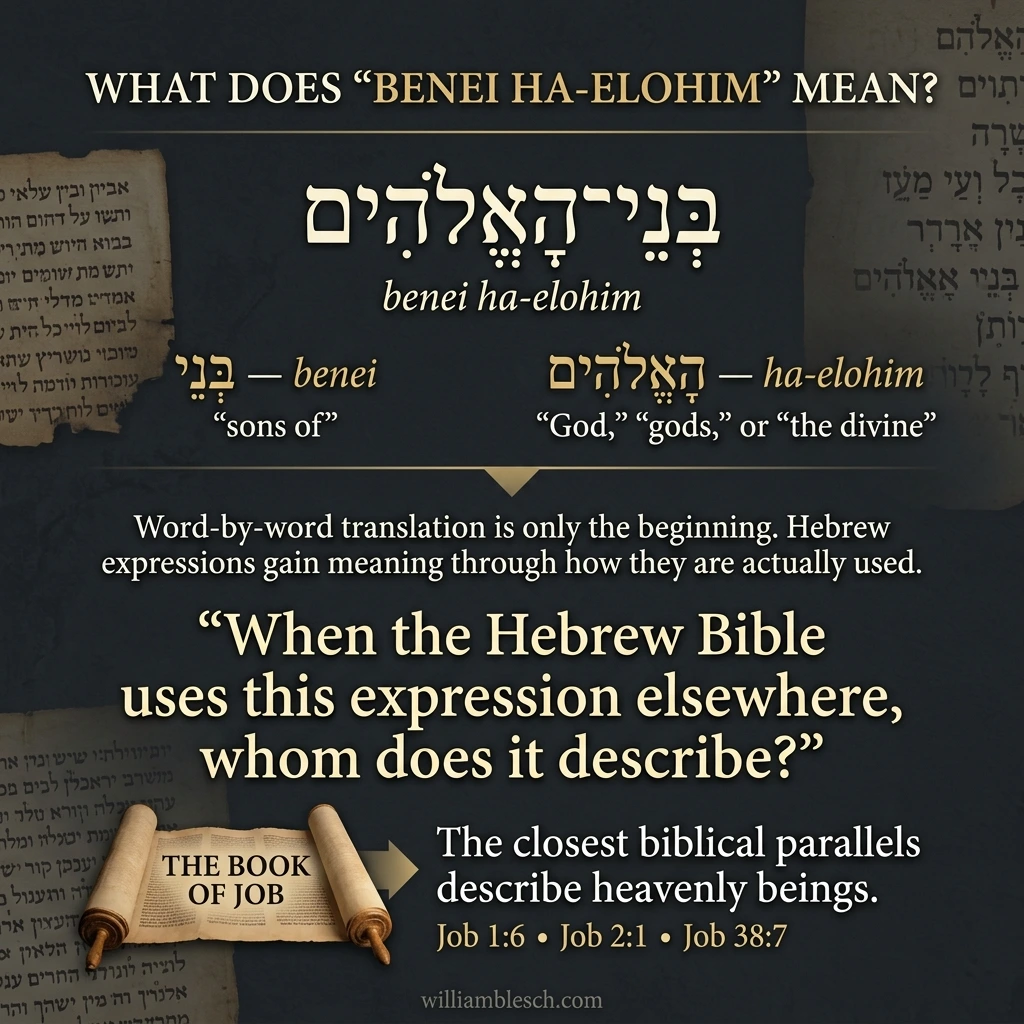
Genesis 6:2 introduces the בְנֵי־הָאֱלֹהִים — benei ha-elohim, usually translated “sons of God,” who see the daughters of humankind and take wives from those they choose.
That wording creates a deliberate contrast. On one side stand the sons of God, and on the other stand the daughters of Adam, the daughters of mankind.
The text does not:
- Call the men “sons of Seth”
- Mention Cain; or
- Introduce kings, nobles, judges, aristocrats, or warrior dynasties.
Instead, it gives us a category:
“Sons of God.”
Then it gives us another:
“daughters of humankind.” (Lit. the daughters of Adam – בְּנוֹת הָאָדָם)
Of course, that doesn’t settle the interpretation by itself. But, it absolutely should control where the investigation begins. The mistake is to start with what we think these beings must have been and then work backward toward the Hebrew.
Better to ask the harder question.
What did the phrase “בְנֵי־הָאֱלֹהִים — benei ha-elohim” already mean?
What Does Bene Ha-Elohim Mean?
The expression in Genesis 6 is built from benei, “sons of,” and ha-elohim, “God,” “gods,” or “the divine.”
Word-by-word translation only gets us so far. Hebrew expressions acquire meaning through usage. The real question is therefore not whether benei means sons or elohim means God.
It’s actually, “when the Hebrew Bible uses this expression elsewhere, whom does it describe?”
That brings us immediately to the book of Job. And, let’s just say Job is difficult terrain for the human interpretations.
The Sons of God in Job
In Job 1:6, the sons of God present themselves before YHWH (Yaweh).
Satan also appears among them.
The scene is heavenly. Nobody seriously imagines that Job has suddenly transported us to a reunion of Seth’s descendants. Then, the same scene returns in Job 2:1.
Again, the sons of God appear before YHWH as members of the heavenly assembly. Importantly, the Septuagint translators understood the expression in Job as referring to angels, rendering the sons of God as “the angels of God.”
Then comes Job 38:7.
God is interrogating Job from the whirlwind and describing the creation of the world. The morning stars sing together and the sons of God shout for joy.
Obviously, that timing is awkward for any interpretation that requires the phrase to mean an ordinary human lineage. Can anyone point to some Sethites watching creation, here? Of course they can’t.
Further, there are no human kings of any sort. There are no human aristocrats standing around while God lays the foundations of the earth. Whatever theological vocabulary we prefer for these beings (e.g., angels, members of the divine council, heavenly beings) the category is not difficult to recognize.
They belong to the heavenly realm.
Admittedly, that doesn’t mathematically force Genesis 6 to use the expression in the exact same way that the book of Job does. Context can, and often does, alter meaning. But, the burden of explanation now shifts.
If benei ha-elohim refers to heavenly beings in the clearest biblical parallels, what in Genesis 6 requires us to read the phrase differently?
That question deserves a precise answer.
The Wider Biblical World of Heavenly “Sons”
Job is not standing alone.
Related language appears in biblical passages describing a heavenly assembly. Psalms 29 and 89 use closely related expressions involving the “sons of gods” or divine beings. The exact Hebrew forms vary, so they should not be treated as mechanically identical to Genesis 6.
Still, they belong to the same conceptual world: YHWH surrounded by heavenly beings who are subordinate to him.
Deuteronomy 32:8 adds an intriguing textual wrinkle.
The traditional Masoretic Text speaks of the nations being divided according to the number of the “sons of Israel.” But a Dead Sea Scroll manuscript, 4QDeutᶿ, preserves “sons of God,” while Greek witnesses preserve either “sons of God” or “angels of God.”
Emanuel Tov argues that the divine-being reading fits the surrounding passage naturally: the nations are apportioned among heavenly beings while YHWH’s own portion is Jacob.
Whether one accepts every reconstruction of Deuteronomy 32 is not the point here. The larger biblical picture is enough. Ancient Israelite literature was perfectly capable of speaking about a populated heavenly realm using familial language.
“Sons of God” wasn’t polytheistic, pagan infiltration of Scripture. (And it wasn’t superstitious mystics “imposing the supernatural onto the natural.”)
It was part of the ancient Israelite’s vocabulary and cosmology.
Does That Prove the Sons of God in Genesis 6 Were Heavenly Beings?
No.
It still doesn’t. But, it does provide strong evidence.
A lexical parallel can strongly support an interpretation without proving that the same phrase must carry exactly the same meaning in every context.
Humans can also be called God’s children elsewhere in Scripture. Israel is called God’s son. Kings may receive divine-son language. Hosea uses father-son imagery for Israel. Ancient Near Eastern rulers could also be described as sons of deities, particularly in royal ideology.
Recent scholarship continues to document how kingship and divine sonship intersected across the ancient Near East. So merely finding the word son near the word God settles nothing.
But, crucially, that isn’t actually the argument for the heavenly reading.
The argument is cumulative.
The specific expression in Genesis has close parallels in Job where it plainly denotes heavenly beings. And further:
- Genesis contrasts these sons of God with daughters of humankind.
- The oldest surviving large-scale Jewish interpretation of the passage takes the sons of God as heavenly beings; and
- The competing human readings require us to supply identities (e.g., Sethites or kings) that Genesis itself never names.
Taken together, those points create a substantial burden for any interpretation that identifies the “sons of God” as ordinary human beings.
The Heavenly-Being Interpretation
Under the supernatural reading, Genesis 6 describes heavenly beings crossing a boundary into the human sphere.
- They see women.
- They take them.
- Something follows that should not have happened.
The attractiveness of this reading is not that it is dramatic. Obviously, drama proves nothing.
Its strength is that it requires the least linguistic reinvention of the term, “sons of God.”
Job gives us the clearest biblical parallels, Second Temple literature gives us the earliest surviving elaborate interpretation, and the contrast between heavenly sons and human daughters makes immediate sense.
Then there is 1 Enoch, which removes any doubt about how at least one major ancient Jewish tradition understood the passage.
The Book of the Watchers identifies the transgressing beings as heavenly Watchers who descend, take women, and produce monstrous offspring.
The work doesn’t merely contain a passing allusion to Genesis 6. Its rebellion narrative grows from the same ancient world of traditions surrounding heavenly beings, human women, giant offspring, corruption, and the Flood.
Scholars frequently treat Genesis 6:1–4 as the biblical point of departure for the Watchers tradition, although the relationship may be more complicated than a simple case of one text borrowing from the other.
The term “Watchers” itself is biblical. Daniel uses the Aramaic term “irin” for heavenly beings, perhaps a particular class, designation, or group within the celestial realm. The same terminology appears in Enochic literature, where the Watchers are described as “sons of heaven.”
Chronology requires some care.
The physical manuscripts we possess are not the original compositions. The oldest surviving copies of Genesis and the earliest surviving Enochic manuscripts both preserve texts whose literary and oral histories extend much further back than the parchment fragments themselves.
The Book of the Watchers also appears to be a composite. Its authors drew on earlier material, including traditions with Mesopotamian and other ancient Near Eastern parallels.
Indeed, scholars working on the development of the Watchers tradition explicitly recognize that its writers adapted older traditions rather than inventing the entire narrative from scratch.
That leaves open a possibility worth taking seriously.
Genesis 6 and the Enochic Watchers material may not stand in a simple relationship in which a later author merely read Genesis and expanded four difficult verses into a supernatural story.
Instead, they may preserve different literary forms of older traditions that circulated before the surviving versions of either text. Those traditions could have been oral, written, or both.
And, while a specific lost source shared by Genesis and 1 Enoch remains hypothetical, the existence of older underlying tradition isn’t a fringe proposition.
So, the age of a surviving manuscript cannot tell us which tradition came first. And, the fact that the Book of the Watchers reached its surviving form later than Genesis doesn’t mean every tradition preserved inside it originated later than the Genesis account.
Now, that doesn’t prove the Enochic interpretation is identical to the original intent of Genesis either. However, it does mean the relationship between the two is more historically complicated than “Genesis came first, and Enoch later invented the rest.”
The bottom line is that it gives us something historically valuable: an early Jewish reading in which nobody seems embarrassed by the idea that Genesis is describing heavenly beings.
The uneasiness from certain theologians, which became the human interpretation of “sons of God” came much later.
But Can Angels Have Bodies?
This is where the theological resistance usually becomes audible.
- Angels are spirits!
- Spirits do not have gender or sexual organs!
- Therefore Genesis 6 cannot describe heavenly beings!
Of course, that argument sounds simple, but only because it assumes several things that the text itself never actually says.
Biblical angelic beings repeatedly interact with the physical world in ways that are difficult to reduce to disembodied apparitions. For example:
- They appear as men.
- They enter houses.
- They seize people by the hand.
- They eat.
- They strike.
- They are mistaken for ordinary travelers.
Genesis 18–19 is especially awkward for an overly tidy doctrine of incorporeal entities.
- Abraham’s visitors eat food.
- The men of Sodom want sexual access to the visitors who arrive at Lot’s house. (Whatever one concludes about angelic ontology, the narrative assumes embodied interaction serious enough for the inhabitants of Sodom to regard these visitors as physically accessible.)
Then there is Matthew 22:30, where Jesus says that in the resurrection people neither marry nor are given in marriage but are like the angels in heaven. Of course, that verse deserves careful treatment.
Jesus is describing the resurrection and answering a question about lawful marriage.
What He isn’t doing, is giving a metaphysical lecture on every capacity possessed by every heavenly species under every condition.
More importantly, Genesis 6, under the supernatural reading, would describe divine cosmic rebellion. Appealing to the normal behavior of obedient angels to prove what rebellious heavenly beings cannot do assumes the conclusion.
Still, caution is warranted.
Genesis never explains the mechanism.
It doesn’t tell us whether heavenly beings possess permanent physical bodies.
Although Jesus seems to have a permanent, physical body following the resurrection and presumably sits in Heaven at the right hand of the Father … with a physical body … and Judaism has taught a physical resurrection of the dead as doctrine for thousands of years.
Thus, “heavenly” and “physical” are not automatically opposites.
Granted, neither Jesus nor believers are angelic beings.
But the Hebrew Scriptures and the New Testament suggest that some or all actual angelic beings may assume bodily form, manipulate human reproduction, or do something stranger.
1 Enoch is more explicit about intercourse and offspring.
So the real problem with the supernatural interpretation is not that Scripture clearly rules out physical interaction between heavenly beings and humans.
It doesn’t.
The problem is that Genesis leaves us with an event that it simply does not explain.
The Sethite Interpretation
The Sethite view reads the sons of God as the godly male descendants of Seth and the daughters of men, as women from Cain’s corrupt lineage.
And, there actually is an internal logic to it.
- Genesis 4 develops Cain’s line.
- Genesis 5 develops Seth’s.
- Then Genesis 6 describes intermarriage and escalating corruption before the Flood.
Read that way, the passage becomes a story about the collapse of a godly human lineage through compromised marriage.
Now, this reading became deeply rooted in Christian interpretation, so deeply in fact, that many readers encounter it as though it were simply what Christians have always believed. However, the real history is more complicated.
The first problem, as we’ve been discussing until now, is textual. Genesis never calls Seth’s descendants sons of God.
Not once.
Nor does it identify the “daughters of humankind” (again, daughters of Adam in the Hebrew) as Cainite women. That identification is inferred because the theory needs two human genealogical camps.
But the language is oddly asymmetrical if that is what Genesis intends. Why are male Sethites called “sons of God” while female Cainites suddenly become the generic “daughters of humankind”? What happened to Sethite women?
What happened to Cainite men?
The theory can answer those questions. But, the text itself never does.
Then the book of Job comes along again, holds up a finger, and says “Uh, excuse me …”
If the same rare expression points to heavenly beings in Deuteronomy (e.g., Dead Sea Scrolls and Septuagint), and the book of Job, a Sethite reading needs positive evidence that Genesis has deliberately reassigned that term to one particular human bloodline.
The genealogical proximity of Genesis 4–5 may be evidence. Whether that’s grounds enough for the Sethite theory is another matter.
A 2026 paper by Samuel Ken-En Gan argues for a specifically human interpretation of the sons of God, maintaining that Genesis should be read according to a human creation framework despite acknowledging that the expression elsewhere can refer to spiritual beings.
That argument deserves a proper response.
I plan to write one.
But the central lexical difficulty remains: every other biblical occurrence of this expression (or its virtually identical form in Job 38:7) refers to heavenly beings. A human interpretation of Genesis 6 must therefore explain why the same language should suddenly refer to ordinary human beings here.
The Sethite View Was Not Always the Dominant Christian Reading
The history here is revealing.
The angelic reading appears prominently in early Jewish interpretation and continued among early Christian writers. Later, a rationalizing human interpretation became increasingly prominent.
J. J. T. Doedens’ study of the history of Genesis 6 exegesis traces a Sethite-type interpretation becoming prominent in patristic Christianity from Julius Africanus onward. Eventually figures such as Augustine helped push Christian interpretation further away from the angelic reading.
Of course, that shift had consequences.
The older Enochic framework gradually moved toward the margins of much Western Christianity, even while the Book of the Watchers and related traditions had exercised considerable influence in pre-rabbinic Judaism and early Christianity.
Annette Yoshiko Reed has traced that process in detail, including the later marginalization of Enochic literature.
Now, none of this proves Julius Africanus or Augustine wrong. Late interpretations can be correct and early interpretations can be wrong.
But historical sequence prevents one rhetorical shortcut: the Sethite view cannot simply be presented as the obvious ancient consensus while the angelic reading is treated as modern sensationalism.
The Royal or Ruler Interpretation
The third major proposal identifies the sons of God as human kings, nobles, tyrants, or warrior elites. You’ll find this interpretation inserted into the English text in a wide variety of Jewish bible translations.
“And it came to pass, when men began to multiply on the face of the earth, and daughters were born to them, that the distinguished men saw that the daughters of men were fair; and they took them wives of all whom they chose.” (Genesis 6:1-2, The Koren Jerusalem Bible)
“It came to be when men began to multiply on the face of the earth, that daughters were born to them. The sons of the rulers saw that the daughters of man were fair and they took for themselves wives from whomever they chose.” (Genesis 6:1-2, Metsudah Publications)
“that the sons of nobles saw the daughters of men that they were fair; and they took them wives, whomsoever they chose.” (Genesis 6:2, JPS 1917)
Now, what’s going on here? Why are these translators imposing an interpretation directly onto the text? Isn’t that adding to Scripture rather than letting Scripture speak for itself?
While a great many Christian denominations change the meaning of “sons of God” from an angelic to a human one, at least they don’t go so far as to change the actual wording of Scripture! (Oops, I failed to mention The Expanded Bible (EXB), which gives the distinguished men, nobles, and rulers interpretation in brackets immediately following the text, )
And, to be fair, some Jewish English translations retain the term “sons of God” or they use the term “divine beings.”
In any case, kings in the ancient Near East could received divine or semi-divine sonship language. Egyptian kings could be called sons of deities. Biblical royal ideology also uses sonship language in places such as Psalm 2.
Now, moving forward, the phrase in Genesis that the sons of God took women “whomever they chose” can also sound ugly in a very human way (and indeed these verses in Hebrew do carry a sexually violent connotation).
- Powerful men see women.
- They take them.
- No permission is mentioned.
Read politically, Genesis 6 becomes a picture of predatory rulers exercising sexual power without restraint. There is something attractive about that interpretation because it fits the brutal economics of ancient kingship.
It brings to mind Mel Gibson’s film, “Braveheart” where a lord exercises his “right” of Prima Nocta –the alleged medieval “right of the first night” which was the supposed privilege of a feudal lord to have sexual relations with a newly married woman – particularly a serf or subordinate’s bride – on her wedding night before her husband did.
In this scenario, the daughters of Adam became dynastic currency. But still, the lexical evidence is weak. Individual kings can be called sons of a deity. Israel collectively can be called God’s son.
But, it is impossible to demonstrate that bene ha-elohim functions elsewhere as a recognized collective title meaning “human kings” or “aristocrats.”
- Genesis does not mention thrones.
- No royal court appears.
- No dynasty is named.
With that said, ancient Jewish interpreters did sometimes move in this direction. Targumic and related traditions (the Aramaic paraphrases of the Hebrew Scriptures) contain “mighty ones” or human-ruler readings, which means human interpretations are not merely modern inventions either.
Doedens’ history of exegesis makes that diversity clear, so it’s worth remembering that Second Temple Judaism was not one man with one commentary.
What Did Ancient Jewish Readers Think Genesis 6 Meant?
The answer depends on which ancient Jewish readers we mean. There was no committee issuing an approved interpretation. But, the supernatural reading has a formidable early footprint.
- The Book of the Watchers takes the sons of God as heavenly beings and builds an entire account of cosmic rebellion around their descent.
- The book of Jubilees also preserves an angelic interpretation.
- The Book of Giants develops the consequences of the same tradition.
Watchers and giant material appears across the Dead Sea Scroll corpus. Scholars describe the Watchers tradition as an influential strand of Second Temple Jewish thought, not as an isolated curiosity.
The Book of the Watchers itself is especially revealing because it doesn’t pause to argue:
“By the way, we know these were angels.”
That’s simply the conceptual world of the story.
Other Jewish interpretations eventually humanize the passage, but chronology here matters. The heavenly reading isn’t something imposed on Genesis after medieval demonology or modern UFO culture.
It was already there while the Second Temple still stood.
The New Testament Complicates the Picture
Neither Jude nor 2 Peter says:
“The sons of God in Genesis 6 were angels.” That exact sentence does not exist.
Yet both letters contain material that sits remarkably close to the Watchers tradition.
Jude 6 speaks of angels who did not keep their own domain but abandoned their proper dwelling and were kept in bonds for judgment.
The next verse invokes Sodom and Gomorrah and sexual immorality.
Jude later quotes 1 Enoch directly. And, while the apostle could have quoted Genesis, he chose Enoch instead. That’s telling. Scholars have long recognized that Jude is drawing from Enochic material and that the Watchers story belongs to the conceptual background of the epistle.
Then 2 Peter 2:4–5 speaks of angels who sinned, their confinement for judgment, and immediately moves to Noah and the ancient world destroyed by the Flood.
The sequence is difficult to ignore.
- Angelic sin.
- Judgment.
- Noah.
- Flood.
Scholarship on the reception of the Watchers tradition notes that Jude, 2 Peter, and even 1 Peter preserve independent traces of this conceptual world. (Actually, there are traces of this in Paul’s writings too!)
“Therefore the woman ought to have a symbol of authority on her head, because of the angels.” (1 Corinthians 11:10) – the verse is directly associated with women covering their heads/hair in worship with the Enochian/Genesis 6 tradition as the underlying context.)
Does that prove the apostles were writing a commentary on Genesis 6?
No.
But the idea that the New Testament is completely detached from the Enochic interpretation is hard to sustain.
The threads are obviously visible.
Which Interpretation Best Fits the Evidence?
If we judge the three major readings by Hebrew usage alone, the heavenly-being interpretation has the strongest starting position, hands down.
The key expression in Job points to heavenly beings. That fact cannot simply be waved away because Genesis 6 makes some among us uncomfortable.
The Sethite interpretation gains strength from the genealogy immediately preceding the passage and from the broader biblical idea of humans belonging to God as sons. Although, it should be noted that only two human beings are ever directly called sons of God in Scripture. Namely, Adam the son of God (Luke 3:38), and Jesus the Son of God (Luke 1:35).
But Genesis never calls the Sethites “sons of God,” nor does it identify the “daughters of men” as Cainite women. Both identities have to be added to the text by the interpreter.
The ruler interpretation gains plausibility from ancient royal sonship and the predatory language of powerful males taking women as they choose. But, the passage never says these figures are kings, and evidence for the exact phrase as a collective title for human rulers is beyond weak.
Then ancient reception enters the room.
The supernatural interpretation is early. Very early.
And, it is not represented by a single stray text. The Watchers tradition spread across Enochic literature, Jubilees, Qumran material, and later early Christian interpretation.
What this means, is that an interpretation that fits the Hebrew usage also happens to be the one embedded in some of our earliest surviving interpretive traditions.
What Can We Actually Say With Confidence?
Genesis calls the figures bene ha-elohim, the sons of God. In Job, the same expression denotes heavenly beings. That’s firm ground.
Human beings elsewhere can certainly be called God’s sons (Scripture explicitly does so twice), so the phrase does not create a metaphysical rule forbidding human application under every conceivable context.
But, Genesis itself never calls these figures Sethites. It never calls them kings. And, the earliest surviving major expansion of Genesis 6 identifies them as heavenly beings.
Later Jewish and Christian interpretation becomes more diverse. The exact mechanism by which the Genesis 6 unions occur remains obscure in Genesis itself. 1 Enoch fills in the blanks aggressively. Genesis does not.
Bottom line: A supernatural reading does not require pretending we know more than the text tells us.
Will Blesch’s Interpretation
So what do I think? Well, I think the sons of God in Genesis 6 were rebellious heavenly beings. And, not because 1 Enoch tells me I have to believe that. And, it’s not because the supernatural interpretation makes for a more interesting book cover.
The Hebrew is the problem.
Or, more precisely, the Hebrew is the problem for the human interpretations.
When bene ha-elohim appears in Job, nobody feels compelled to search for a hidden genealogy of Seth or a council of Bronze Age kings. The scene itself won’t permit it. These are heavenly beings standing before YHWH.
In Job 38 they are already there rejoicing when God lays the foundations of the earth.
Then we arrive at Genesis 6 and suddenly the terminology is asked to change uniforms. And why? Obviously, because of what comes next.
The sons of God take women and that creates theological discomfort for some. I understand that. I just don’t think discomfort is an exegetical category.
If Genesis used an otherwise ordinary word for “men,” “rulers,” “princes,” or “descendants of Seth,” the supernatural interpretation would have a much steeper hill to climb.
But it doesn’t.
It gives us sons of God and daughters of humankind. That’s a contrast of categories. That’s not human men with human women. If it were, there would be no for a contrast here at all. The language used is intentional, and it truly does matter.
To me, the most natural reading is that Genesis is describing a violation of categories. Something belonging to the heavenly realm crosses into the human one.
That reading also fits the way Genesis builds its story: each rebellion becomes more serious, until the corruption reaches beyond ordinary human sin and affects the created order itself.
Genesis 3 gives us a rebellion involving humanity and a non-human adversary.
Genesis 4 gives us fratricide.
Genesis 6 escalates the disorder again – and this time, non-human entities are invading Earth, seeking to essentially supplant humanity with their offspring … beings “just human enough” to legitimately, and legally, seize and rule the planet.
Something the apostate sons of God could not legally do themselves.
By the time God looks upon the earth, the problem is not merely that humanity has no morality. The earth is filled with violence. Flesh itself is described as corrupted. (And corrupted how? Well, the mixing of the DNA of an ancient race … one that behaved in a predatory manner … with humanity, which God had only recently create.)
Clearly, something has gone badly wrong.
I also give considerable weight to the antiquity of the Watchers interpretation, though not the kind of weight that turns 1 Enoch into a second Torah.
I read much of 1 Enoch as something closer to apocalyptic midrash: ancient interpretation, expansion, memory, theology, and inherited tradition woven together.
That means I am perfectly willing to say that Enoch can embellish. What I am not willing to say is that embellishment equals invention. Those are completely different claims.
The Book of the Watchers appears to contain material drawn from older traditions, and scholars have identified layers within the work that may reach well behind its final form.
So I am wary of the easy modern picture in which somebody sat down centuries after Genesis, read four strange verses, and simply invented angels, forbidden knowledge, hybrid offspring, and cosmic rebellion out of whole cloth.
The reverse possibility deserves air too: Genesis and Enoch may preserve different forms of older traditions whose full contours are no longer available to us.
In fact, some scholars have argued that Genesis and the Enochic traditions may preserve material drawn from older traditions or a shared stream of tradition, though a specific common written source remains hypothetical.
That prospect changes how I read the passage.
I suspect Genesis 6 preserves the compressed memory of some kind of actual interference in human affairs by non-human intelligences.
I don’t pretend to know the mechanism. Perhaps the ancient language is phenomenological. Maybe it’s theological. In many ways, I suspect the early chapters of Genesis are allegorized history.
Perhaps it’s all three.
What I resist is the reflex that says the supernatural category must disappear before interpretation can begin. If the text says sons of God, then sons of God should at least be allowed into the courtroom before being escorted out for making modern theology uncomfortable.
If the supernatural reading is correct, then Genesis 6 may preserve only the faint outline of something much larger.
I suspect Genesis and the Enochic traditions are compressed, almost cartoon-like memories of a real incursion by non-human beings – an event that altered human civilization, ended in catastrophe, and survived only in fragments carried forward by those who came after.
In that sense, the texts may be less like complete histories than echoes.
And some of those echoes sound disturbingly familiar to modern discussions of non-human intelligence.
I explore this possibility in greater depth in In the Shadow of Goliath, where I examine the Watchers, Nephilim, ancient accounts of non-human intelligence, and the possibility that these traditions preserve memories of something far older and stranger than later interpreters assumed.
Frequently Asked Questions
What does “sons of God” mean in Hebrew?
Genesis 6 uses bene ha-elohim, literally “sons of God.” The same expression in Job 1:6, 2:1, and 38:7 refers exclusively to heavenly beings.
Technically, as we discussed earlier, Job 38:7 has the nearly identical בְּנֵי אֱלֹהִים — bene elohim rather than the articulated בְּנֵי הָאֱלֹהִים — bene ha-elohim of Genesis 6:2/4 and Job 1:6/2:1.
Context still matters, so the overall phrase cannot be interpreted by word substitution alone.
Are the sons of God angels?
The heavenly-being interpretation identifies them with members of the heavenly realm. Later Second Temple literature, especially 1 Enoch, explicitly interprets the Genesis figures as Watchers or angels. Genesis itself uses the broader expression “sons of God.”
In all Scriptural usage outside Genesis, the term “sons of God” is exclusively angelic in nature, with no dispute.
Were the sons of God fallen angels?
Genesis does not use the phrase “fallen angels.” In fact the term “fallen angels” is not a biblical one at all.
Under the supernatural interpretation, the sons of God in Genesis 6 are heavenly beings who rebelled by crossing a prohibited boundary. In Enochic literature these same sons of God are called Watchers.
However, it is worth noting that the “sons of God” mentioned in the book of Job are loyal to the King of Heaven, and are not rebellious at all. Therefore, “sons of God” may refer to both good and rebellious angelic beings.
The term alone does not suggest a being who is either good or bad. Instead, it is a title reserved for a class of being.
Who were the daughters of men?
The Hebrew refers broadly to daughters of humankind (Lit. the daughters of Adam – בְּנוֹת הָאָדָם). Genesis never calls them daughters of Cain. That identification belongs to the Sethite interpretation.
Does Matthew 22:30 prove angels cannot marry?
Matthew 22:30 says resurrected people will not marry but will be like the angels in heaven. The passage describes the normal heavenly order and the resurrection state. Whether it also defines the physical capacities of rebellious heavenly beings in Genesis 6 is debated.
Does the Book of Enoch identify the sons of God as Watchers?
Yes. The Book of the Watchers interprets Genesis 6 through the story of heavenly Watchers (also mentioned in the book of Daniel) who descend, take human women, and produce giant offspring. That interpretation became highly influential in Second Temple Jewish and early Christian traditions.
Final Thoughts
The sons of God are not difficult because the Hebrew gives us no clues.
The clues are there.
The difficulty begins when those clues point somewhere many modern readers would rather not go.
The strongest biblical parallels place the sons of God in heaven. Early Enochic interpretation does the same. Jubilees follows. As do other Jewish literary works from the Essenes (Dead Sea Scrolls) on down to later mystical texts.
The New Testament texts still carry traces of the Watchers tradition.
None of that forces us to accept every detail of Enochic literature. But, it does force a choice.
Either the heavenly language in Genesis 6 means what identical heavenly language means elsewhere, or there must be something in Genesis 6 itself that requires us to read “sons of God” as human beings instead.
If such evidence exists, it should be identified in the text.
If it is not, then the burden falls on the human interpretation to explain why the phrase should mean something different here.
Otherwise, the difficulty may not be with the supernatural reading at all.
It may simply be that Genesis 6 is describing something genuinely extraordinary.
Works Cited and Further Reading
Primary Texts
- The Holy Bible. Biblical passages discussed include Genesis 6:1–4; Deuteronomy 32:8; Job 1:6, 2:1, 38:7; Psalms 29, 82, and 89; Daniel 4; Matthew 22:30; 1 Corinthians 11:10; Jude 6–15; and 2 Peter 2:4–5.
- Nickelsburg, George W. E., and James C. VanderKam. 1 Enoch: The Hermeneia Translation. Fortress Press, 2012. This edition incorporates the Ethiopic, Greek, and surviving Aramaic textual evidence for 1 Enoch.
- The Book of Jubilees. Especially the Watchers traditions associated with the primeval history and Flood narrative.
- The Book of Giants. Surviving Aramaic fragments from the Dead Sea Scrolls preserving traditions concerning the giant offspring associated with the Watchers.
Scholarship
- deSilva, David A. The Jewish Teachers of Jesus, James, and Jude: What Earliest Christianity Learned from the Apocrypha and Pseudepigrapha. Oxford University Press, 2012. See especially chapter 5, “The Book of Enoch: The Order of God’s Cosmos and the Consequences of Violations.”
- Doedens, J. J. T. The Sons of God in Genesis 6:1–4: Analysis and History of Exegesis. Oudtestamentische Studiën 76. Brill, 2019.
- Gan, Samuel Ken-En. “Who Are the Sons of God and Nephilim in Genesis 6?: An Exegetical, Theological, and Scientific Evaluation.” The Journal of Inductive Biblical Studies, vol. 9, no. 2, 2026, pp. 82–93.
- Harkins, Angela Kim, Kelley Coblentz Bautch, and John C. Endres, editors. The Watchers in Jewish and Christian Traditions. Fortress Press, 2014.
- Nickelsburg, George W. E. 1 Enoch 1: A Commentary on the Book of 1 Enoch, Chapters 1–36; 81–108. Hermeneia. Fortress Press, 2001.
- Reed, Annette Yoshiko. Fallen Angels and the History of Judaism and Christianity: The Reception of Enochic Literature. Cambridge University Press, 2005.
- Tov, Emanuel. “The Sons of Israel or God? — Deuteronomy 32:8.” TheTorah.com. Discusses the Masoretic, Dead Sea Scroll, and Septuagint variants of Deuteronomy 32:8.
- VanderKam, James C. Enoch and the Growth of an Apocalyptic Tradition. Catholic Biblical Association of America, 1984.