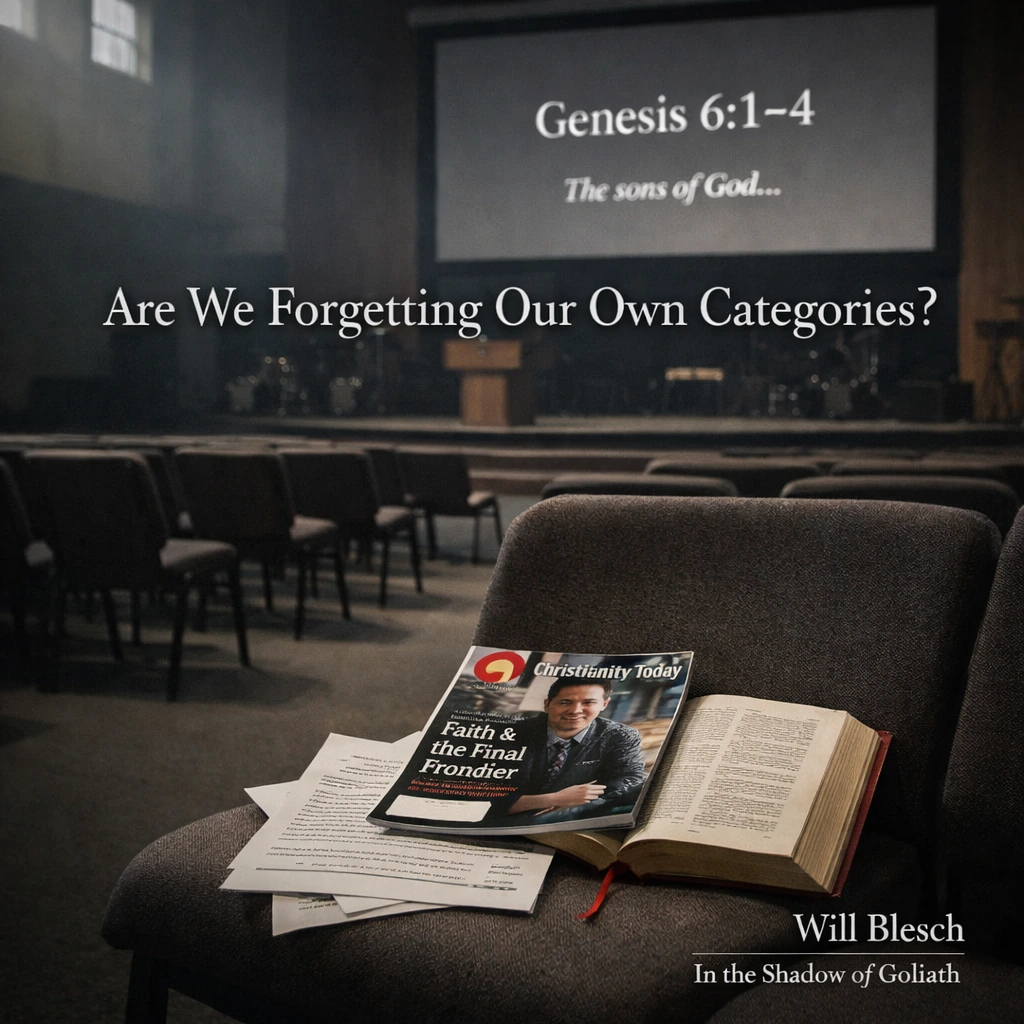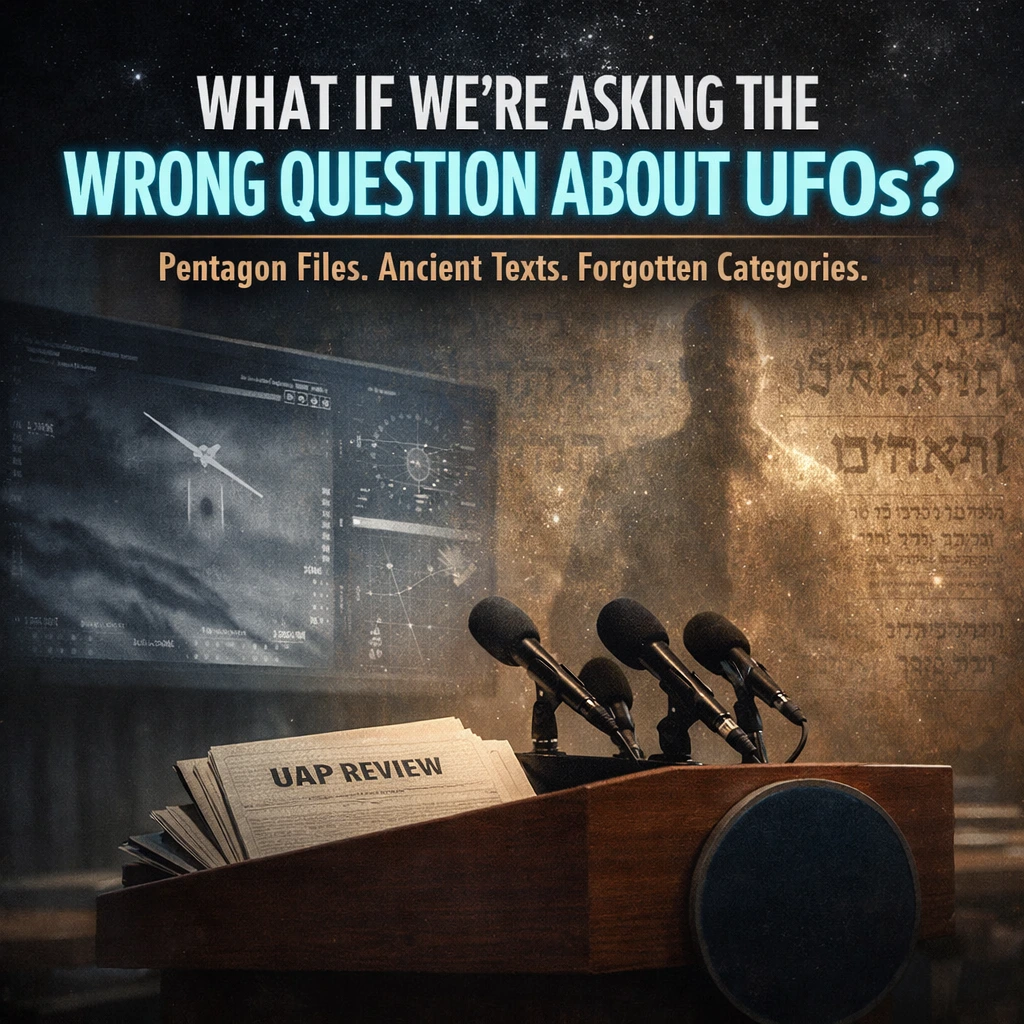
Following Russell Moore’s recent piece in Christianity Today, which rightly argues that Christianity would not collapse if extraterrestrial life were discovered, an important theological layer remains largely unexplored.
Moore’s central point is sound. The biblical worldview has always included non-human intelligences. Namely, angels, fallen angels, demons.
The existence of other conscious beings in the created order would not introduce a category foreign to Scripture. As Hebrews reminds us, Christ’s incarnation addresses humanity specifically, not angelic beings (Heb. 2:16–17).
The theological architecture of Christianity is already expansive.
Yet the discussion often stops there.
When evangelical discourse considers extraterrestrial life, it typically asks whether such discovery would threaten doctrines of creation, incarnation, or human uniqueness.
But the Bible does not merely speak of non-human intelligences in abstract spiritual terms. It also preserves an episode in Genesis 6 that describes a boundary violation between realms.
Genesis 6 and the “Sons of God”
Genesis 6:1–4 records that the “sons of God” took human women and produced the Nephilim. The interpretive debate surrounding this passage is well known.
Some argue that the “sons of God” refer to the descendants of Seth. Others suggest they were human rulers claiming divine status.
However, elsewhere in the Hebrew Bible the phrase bene ha’elohim (“sons of God”) refers to heavenly beings.
In Job 1:6 and 2:1, the “sons of God” present themselves before the Lord. In Job 38:7, they shout for joy at creation.
The lexical continuity is difficult to ignore. As many scholars note, the divine council motif is not a modern invention but a well-documented feature of Ancient Near Eastern cosmology.^1
Second Temple Jewish literature confirms that many ancient readers understood Genesis 6 as describing heavenly beings transgressing proper boundaries.
The Book of the Watchers (1 Enoch 6–16) expands this narrative, identifying the rebellious figures as “Watchers” who descended, corrupted humanity, and were judged.^2
While 1 Enoch is not canonical in most Christian traditions, its historical significance is undisputed. It reflects how Jewish communities prior to the New Testament interpreted Genesis 6.^3
The New Testament itself alludes to this interpretive tradition. Jude references angels who “did not stay within their own position of authority” (Jude 6), language that closely parallels the Watchers narrative.
Second Peter 2:4 similarly speaks of angels cast into chains of gloomy darkness.
Whether one ultimately adopts this interpretation or prefers an alternative reading, it is historically inaccurate to suggest that Genesis 6 was universally understood as metaphor or myth.
For many ancient readers, it described a theological crisis—an incursion that contributed to the corruption preceding the flood.
The Category Problem in Modern Discourse
Contemporary discussions of UAP and non-human intelligence typically assume an astrophysical framework. The question is framed as technological: spacecraft, propulsion systems, biological organisms from distant star systems.
But biblical cosmology is not structured around astrophysics. It is structured around realms, heavenly, earthly, underworld, and populated spiritual beings interacting with humanity at specific moments.
Scripture already contains categories for non-human intelligences capable of agency, communication, and even physical manifestation (Gen. 18–19; Dan. 10).
This does not mean that every reported phenomenon is supernatural. It does not collapse complex reports into a single theological explanation.
It raises a narrower question: are modern categories sufficient, or have we flattened older cosmological frameworks into abstraction?
Theologian Michael Heiser argued that the divine council worldview is foundational to understanding large portions of the Hebrew Bible.^4
Even scholars who disagree with Heiser’s conclusions acknowledge that ancient Israel’s worldview included a populated spiritual order.
The presence of such a framework complicates simplistic claims that Christianity has no conceptual room for non-human intelligences.
The Risk of Theological Amnesia
Russell Moore is correct that Christianity does not hinge on whether extraterrestrials exist. Psalm 8 already situates humanity within a vast and humbling cosmos.
The Incarnation remains central regardless of the scale of the universe. The deeper issue is not alien disclosure. It is interpretive coherence.
If passages like Genesis 6, Job 1–2, Daniel 10, and Jude 6 are reduced to metaphor or sidestepped entirely, modern readers may find themselves unprepared for phenomena that Scripture’s own categories once addressed directly.
In other words, the church’s difficulty may not arise from new discoveries but from selective memory.
The debate, then, is not aliens versus skeptics. It is whether our theological vocabulary has narrowed over time.
The biblical worldview presents a structured spiritual order. Ignoring that structure does not strengthen orthodoxy; it weakens textual consistency.
A More Careful Claim
To be clear:
This argument does not assert that extraterrestrials are fallen angels.
It does not claim that every UAP report fits a biblical model.
It does not elevate Genesis 6 to a central doctrine of salvation.
It simply insists that before we dismiss certain possibilities or default to purely technological explanations, we should revisit the categories embedded in the text itself.
Christianity does not collapse if non-human intelligence exists.
But if Genesis 6 describes a real boundary violation between realms, then the biblical story includes more than abstract spirituality. It includes a history of interaction that modern discourse may be rediscovering under new language.
The pressing question is not whether faith survives alien disclosure.
The pressing question is whether we have fully grappled with our own texts, not to mention our past.
Will Blesch
Author, In the Shadow of Goliath
Citations:
- Michael S. Heiser, The Unseen Realm: Recovering the Supernatural Worldview of the Bible (Bellingham, WA: Lexham Press, 2015).
- George W. E. Nickelsburg and James C. VanderKam, 1 Enoch: A New Translation (Minneapolis: Fortress Press, 2004).
- Loren T. Stuckenbruck, The Myth of Rebellious Angels: Studies in Second Temple Judaism and New Testament Texts (Grand Rapids: Eerdmans, 2014).
- Michael S. Heiser, “Divine Council,” in Dictionary of the Old Testament: Wisdom, Poetry & Writings, ed. Tremper Longman III and Peter Enns (Downers Grove, IL: IVP Academic, 2008).