Published: April 7, 2026
Author: Will Blesch
Editorial policy: Click to View
Overview
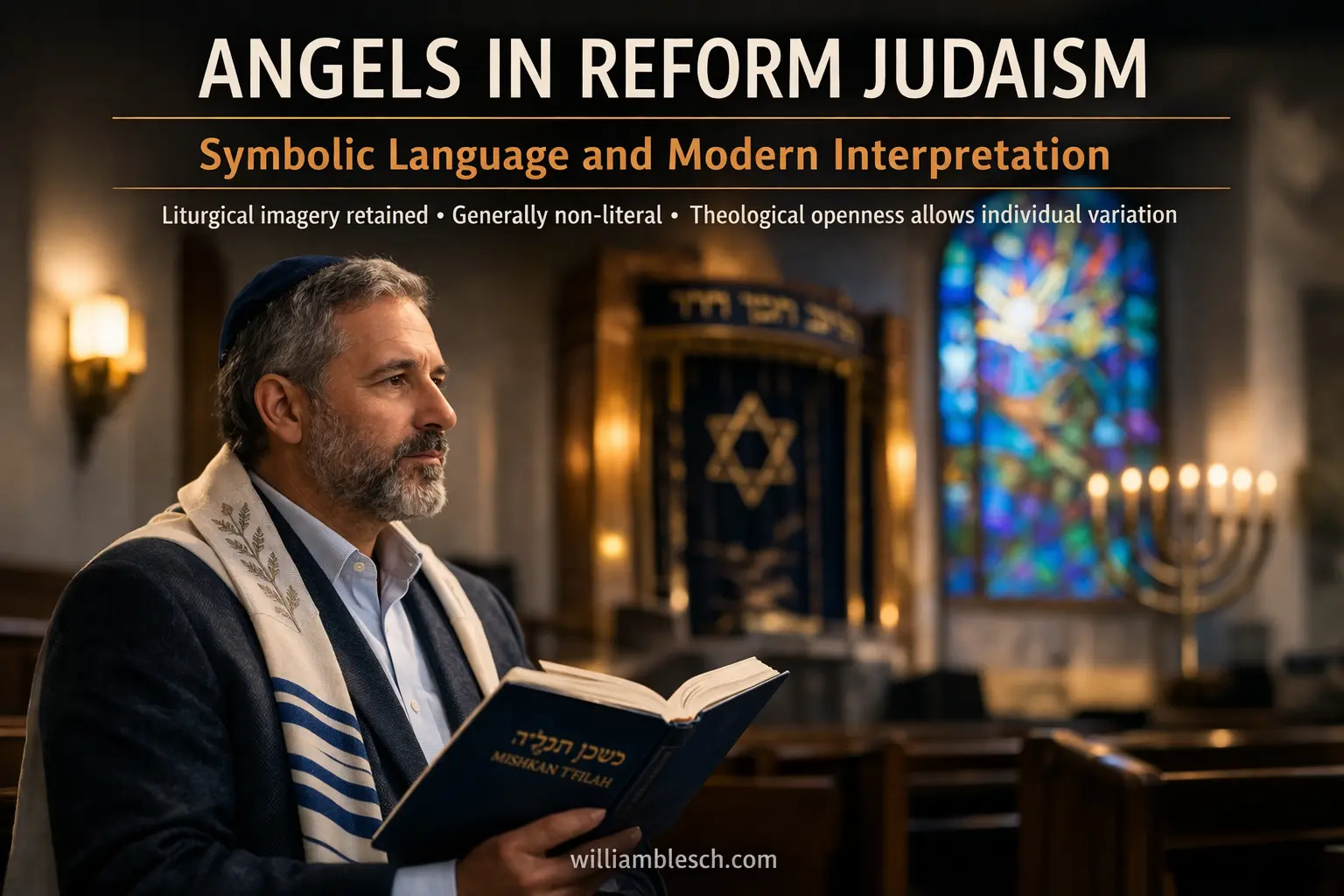
Reform Judaism and Reconstructionist Judaism generally interpret images of angels in non-literal terms, though they do so through different theological frameworks and with different levels of institutional consistency. In Reform Judaism, official statements, liturgical commentary, responsa, and major theological voices usually treat angelic language as symbolic, poetic, mythic, or metaphorical, even if the movement does not impose a fixed doctrine on every adherent. [1][2][3][4][5]
In Reconstructionist Judaism, the picture is more direct. The movement’s Kaplanian naturalism has produced a clearer and more stable institutional position in which references to angels are usually understood as symbolic personifications rather than as descriptions of objectively existing supernatural beings. [6][7][8][9]
The strongest supported conclusion is that both movements generally treat images of angels as symbolic. Reform Judaism appears to leave more room for private variation among lay adherents than Reconstructionist Judaism. [2][4][6][7][10]
Reform Judaism and Angelic Imagery
Symbolic interpretation in official and semi-official sources
Classical Reform Judaism explicitly rejected belief in angels as part of a wider rejection of supernatural doctrines viewed as incompatible with modern religious thought. The Pittsburgh Platform of 1885 remains the clearest early expression of that position. [1]
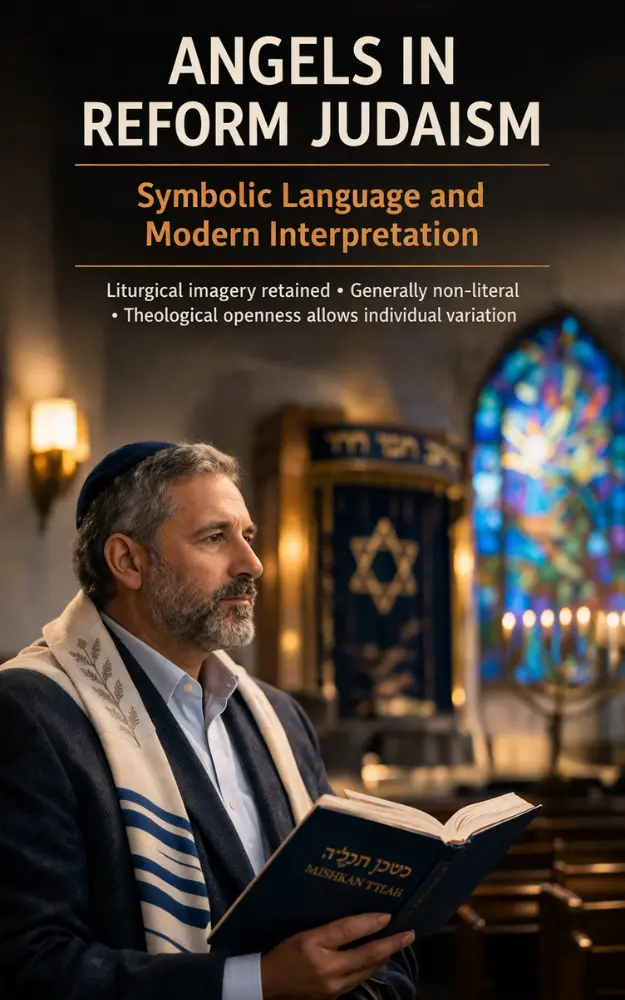
Later Reform statements did not preserve the same polemical edge. Even so, modern Reform liturgical and theological materials usually retain angelic language while reading it in symbolic or poetic terms. This pattern appears in prayer materials such as Mishkan T’filah, as well as in Central Conference of American Rabbis responsa and commentary that describe angels as metaphors, mythic language, or images of divine presence rather than beings whose literal existence is doctrinally required. [2][3][4]
This combination of retained liturgical language and non-literal interpretation supports a careful conclusion: Reform Judaism generally preserves angelic imagery in worship, but its institutional voice usually reads that imagery symbolically. [2][3][4]
Belief and diversity among adherents
Reform Judaism does not impose a binding creed on every theological question, and the evidence cited here does not justify a claim of complete uniformity among members. The most defensible wording is therefore general rather than absolute. [3][5]
The available evidence indicates that Reform theologians, responsa writers, and liturgical editors overwhelmingly interpret angels in symbolic or mythic terms. It also suggests that ordinary adherents usually follow that pattern, though with more private diversity than appears in Reconstructionist settings. [2][3][4][5][10]
It is therefore accurate to say that Reform Jewish adherents generally understand images of angels symbolically, while also recognizing that some individuals may hold more literal private views and that such views do not represent the dominant institutional norm. [2][3][4][10]
Reconstructionist Judaism and Angelic Imagery
Kaplanian naturalism and movement theology
Reconstructionist Judaism reaches a symbolic reading of angels through a more explicit theological framework. In the writings of Mordecai Kaplan, supernatural entities such as angels are treated as personifications of natural forces, human experience, or poetic religious language, not as objectively existing beings in a supernatural realm. [6]
That naturalistic approach appears to have remained stable in later Reconstructionist liturgy and movement materials. Official prayerbooks associated with the movement reportedly remove or substantially revise many traditional angelic references, and current movement statements continue to interpret such language symbolically. [7][8][9]
For that reason, the claim that Reconstructionist Judaism generally treats images of angels symbolically rests on more than scattered commentary. It is supported by the movement’s founding theology, liturgical practice, and present institutional self-understanding. [6][7][8][9]
Relative uniformity among adherents
The research summary describes Reconstructionist Judaism as more explicit on this issue than Reform Judaism. Because Reconstructionism is more consistently committed to naturalism at the movement level, symbolic readings of angels appear more uniform both institutionally and among adherents. [6][7][8][9]
Even here, careful wording still matters. The evidence supports phrases such as “generally,” “almost uniformly,” or “virtually absent” with respect to literal belief, but it does not establish a precise numerical measure of member belief. [7][8][9][10]
Comparison
Points of overlap
Both Reform and Reconstructionist Judaism preserve at least some inherited Jewish liturgical language that historically includes angels or celestial imagery. In both movements, that language is generally interpreted in non-literal ways. [2][7]
Both movements also regard symbolic, poetic, or mythic readings as more compatible with their theological commitments than a straightforwardly literal supernatural reading. [3][4][6][8]
Points of difference
The main difference lies in theological structure and institutional clarity. Reform Judaism is broader and less doctrinally fixed, so its symbolic treatment of angels is dominant but not absolute in the sense of a binding test of belief. [2][3][5]
Reconstructionist Judaism is more explicit and more consistent because its naturalistic theology leaves less room for affirming angels as literally existing supernatural beings. In that respect, the symbolic reading is not merely common. It is close to normative at the movement level. [6][7][8][9]
What can and cannot be claimed
The evidence supports three claims. First, both Reform and Reconstructionist Judaism generally interpret images of angels symbolically. Second, Reconstructionist Judaism does so with greater institutional consistency. Third, Reform Judaism allows more private variation even though its dominant liturgical and theological voices are also non-literal. [2][3][4][6][7][8][9]
The evidence does not support precise numerical claims about what percentage of adherents in either movement believe in angels literally. It also does not justify the claim that no adherent in either movement holds a literal view. The strongest supported conclusion is therefore qualitative and comparative rather than numerical. [5][10]
Limitations
This conclusion relies in part on institutional and elite sources such as platforms, responsa, theologians, and prayerbook commentary. Those sources are appropriate for describing movement norms, but they are not the same as direct survey evidence of every adherent’s private beliefs. [1][2][3][4][6][7][8][9]
The evidence for Reform Jewish adherents is less uniform than the evidence for Reconstructionist adherents. Reform Judaism’s theological pluralism makes it more accurate to speak of a dominant tendency than a universal rule. [3][5]
The research summary refers to survey and observational material, but without a direct survey question on angel belief, the most defensible phrasing remains that symbolic interpretation is general or predominant, not total. [10]
If you’re interested, you can also learn about angels in Conservative Judaism here.
References
- Pittsburgh Platform (1885).
- Mishkan T’filah (CCAR, 2007) and related liturgical commentary.
- CCAR Responsa 5751.4.
- CCAR Responsa 5760.11.
- A Statement of Principles for Reform Judaism (1999), with earlier Reform platforms including the Columbus Platform (1937) and Centenary Perspective (1976) as contextual movement statements.
- Mordecai Kaplan, Judaism as a Civilization (1934).
- Mordecai Kaplan, The Future of the American Jew (1948).
- Kol Haneshamah siddur series (Reconstructionist prayerbooks).
- Reconstructing Judaism website, current belief and theology materials.
- Pew Research Center, Jewish Americans in 2020 (used cautiously as indirect context for supernatural belief patterns rather than as a direct angel-belief measure).