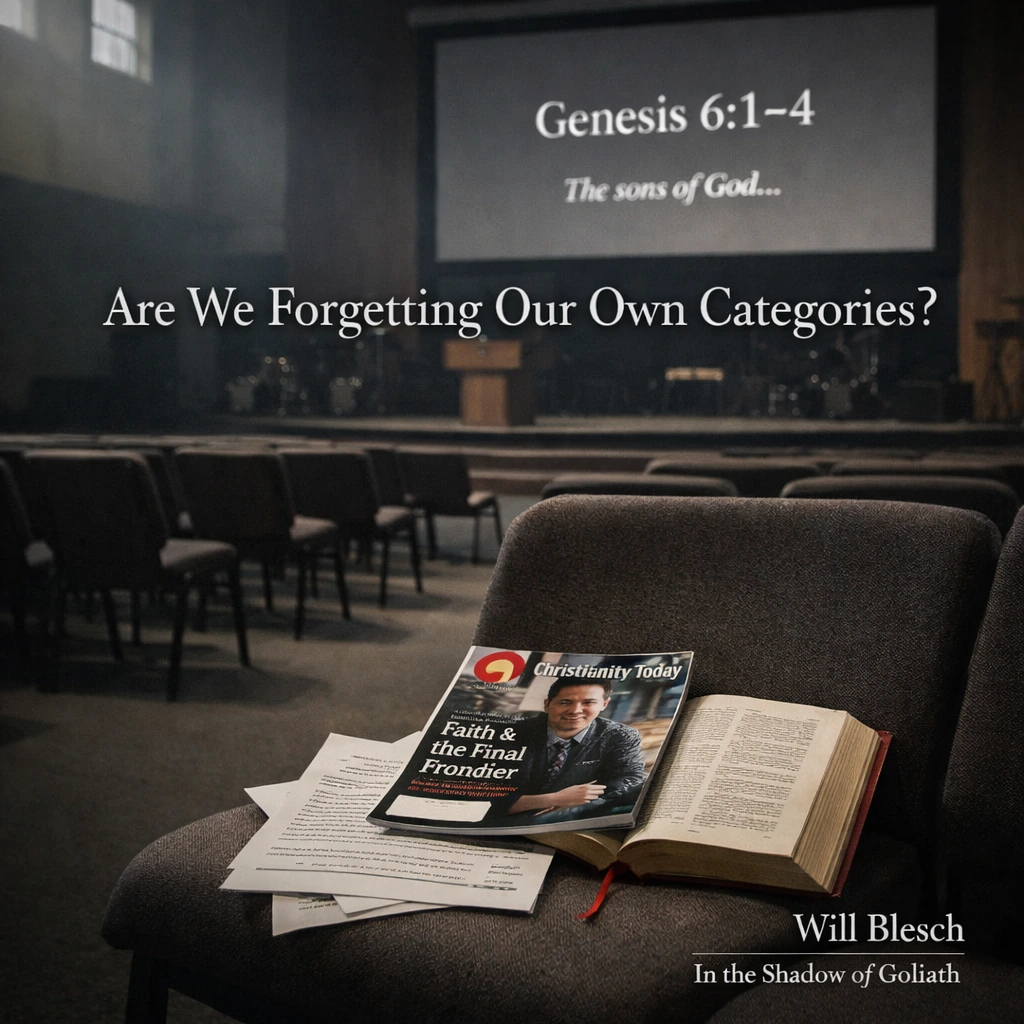

If you have ever read Genesis 6 and felt like something was missing, you are not alone.
Four verses describe the “sons of God,” the Nephilim, and a world on the brink of judgment. Then the text moves on. No footnotes. No extended explanation. Just a strange interruption in the biblical storyline that refuses to disappear.
In the Shadow of Goliath argues that those verses are not a side note. They are a fracture line running through Scripture.
This page is a structured reader’s guide to the book. Because this site is operated by the author, this is not an independent third-party review. It is a clear presentation of the book’s argument, its theological commitments, and the questions it raises so readers can decide whether it is worth their time.
If you are looking for a quick dismissal of UFO reports or a breathless endorsement of ancient astronaut theory, you will not find it here. The claim is narrower and more disruptive.
The biblical worldview already contains a category for non-human intelligences interacting with humanity. The modern debate may be mislabeling what Scripture has long described.
What Is In the Shadow of Goliath About?
At its center, the book makes a simple but loaded claim:
The Nephilim narrative in Genesis 6 is not myth, metaphor, or tribal propaganda. It reflects an incursion event involving rebellious spiritual beings and human corruption, and its consequences echo far beyond the flood.
From that starting point, the book builds in four directions:
-
-
-
- The identity of the “sons of God”
- The Watchers tradition preserved in 1 Enoch
- The reappearance of giant clans in the Old Testament
- The modern language of extraterrestrials and interdimensional beings
-
-
Goliath is not chosen as a dramatic title hook. He is presented as a remnant figure, a late-stage echo of an earlier corruption of humanity. The giant from Gath stands as a visible reminder that Genesis 6 was not erased by the flood narrative.
The book argues that biblical cosmology includes layered realms. Heaven is not a metaphor for clouds. Sheol is not poetry. The divine council passages in Psalms and Daniel are not decorative language. Scripture presents a structured, populated spiritual order that intersects with human history at specific points.
When modern UFO narratives describe luminous beings, genetic manipulation, forbidden knowledge, and hybridization themes, the book asks a pointed question:
Why assume the framework is astrophysics instead of theology?
The Core Argument in Detail
Genesis 6 and the Sons of God
Genesis 6:1 through 4 describes the sons of God taking human women and producing the Nephilim. The traditional alternatives are well known. Some argue the sons of God were descendants of Seth. Others suggest they were ancient rulers claiming divine status.
The book challenges those readings by tracing the phrase “sons of God” across the Old Testament. In Job 1 and 2, the phrase refers to heavenly beings presenting themselves before the Lord. In Job 38, the sons of God shout for joy at creation. The Hebrew grammar does not suggest a human lineage.
Moreover, the concept of a divine council is well documented in Ancient Near Eastern studies and is not a modern invention.
If the same phrase appears in Genesis 6, consistency matters. The text presents a boundary violation between realms.
This is not presented as mythology borrowed from Babylon. It is presented as a theological crisis that precedes the flood.
The Watchers and 1 Enoch
The book does not treat 1 Enoch as Scripture. It treats it as historical commentary.
1 Enoch expands the Genesis 6 narrative, naming the rebellious beings as Watchers and describing their descent, their corruption of humanity, and their judgment. The New Testament book of Jude references Enoch directly. Second Temple Jewish literature assumes familiarity with the Watchers tradition.
Additionally, scholars of Second Temple Judaism note that the Watchers tradition was widely circulated in Jewish communities prior to the New Testament period.
The question is not whether Enoch is canonical. The question is whether it preserves interpretive traditions that shaped early Jewish and Christian thought.
The book lays out where Enoch aligns with Genesis and where it extends beyond it. Readers are shown the parallels rather than told what to think.
Giants After the Flood
If Genesis 6 describes a singular event before the flood, why do giants appear again?
Numbers 13 records the Israelite spies reporting the Nephilim in Canaan. Deuteronomy names the Rephaim. First Samuel introduces Goliath, a warrior with extraordinary stature and equipment that suggests more than simple exaggeration.
The book traces these clans geographically and textually. It asks whether the biblical authors are preserving memory of something abnormal rather than repeating folklore.
Goliath becomes symbolic because he stands in Israel’s path at a critical covenant moment. He is not only large. He is positioned as a living challenge to the promises given to Abraham.
Interdimensional Beings and Modern Phenomena
The most controversial section addresses modern UFO and extraterrestrial claims.
The book does not argue that every sighting is demonic. It does not claim that spacecraft are illusions. It focuses on patterns within reported encounters.
Abduction narratives frequently include:
• Paralyzing presence
• Telepathic communication
• Reproductive themes
• Hybrid offspring
• Messages about human evolution or spiritual awakening
These elements resemble spiritual encounter literature more than aerospace engineering.
If the biblical worldview includes rebellious spiritual beings capable of appearing, speaking, and manipulating physical reality, then the category of “interdimensional being” fits within that cosmology.
The argument is not that aliens are fallen angels in a simplistic sense. It is that modern language may be describing ancient categories with new vocabulary.
Instead of imagining distant galaxies, the book asks whether the conflict is closer, layered within dimensions Scripture already acknowledges.
Theological Strengths
One strength of the book is its refusal to detach the Genesis 6 narrative from the rest of Scripture.
Rather than isolating the Nephilim as a curiosity, the argument ties them to:
• The flood as judgment on corruption
• The conquest narratives in Joshua
• The Davidic covenant
• New Testament references to imprisoned spirits
Passages in 2 Peter and Jude are read alongside Genesis rather than as abstract warnings.
Another strength is its insistence on textual consistency. If a Hebrew phrase refers to heavenly beings in multiple locations, the burden of proof lies with anyone who claims it suddenly shifts meaning in Genesis 6.
The book also avoids collapsing everything into speculation. Where Scripture is silent, it says so. Where traditions extend beyond the text, the distinction is marked clearly.
Where Readers May Disagree
Some readers will object to any connection between UFO narratives and biblical cosmology. They may see the subject as a distraction from core doctrines.
The book anticipates that concern. It does not claim that belief in interdimensional beings is essential to salvation. It argues that ignoring uncomfortable passages weakens theological coherence.
Others may object to the use of 1 Enoch. The concern is understandable. Non-canonical texts can be misused. The book addresses this by distinguishing between authority and historical context. Quoting a text is not the same as canonizing it.
A third objection involves the risk of sensationalism. The book pushes against that by grounding each claim in Scripture before moving into modern parallels.
Readers who prefer a purely material explanation for UFO reports will likely reject the framework. The book does not attempt to force agreement. It presents a model and invites scrutiny.
How This Differs From Ancient Alien Theory
Ancient alien theory generally assumes advanced physical beings from other planets intervened in human history. It reads ancient texts as misunderstood technology reports.
In the Shadow of Goliath rejects that premise.
Instead of asking how spacecraft could appear as fiery chariots, the book asks whether spiritual beings interacting with humanity would be described using the symbolic language available at the time.
Ancient alien theory often diminishes the theological message of Scripture. This book does the opposite. It argues that the spiritual conflict described in the Bible is coherent without importing extraterrestrial civilizations.
The difference is not cosmetic. One framework replaces God with astronauts. The other takes the biblical cosmology seriously on its own terms.
Who Should Read This Book?
-
-
- Theology students who are tired of footnotes that dismiss Genesis 6 without explanation.
- Pastors fielding questions from congregants who have watched documentaries and need more than a shrug.
- Readers of ancient alien theory who suspect the story might be misidentified rather than entirely fabricated.
- Spiritual seekers who sense that reality includes layers beyond the visible but want a structured framework instead of vague mysticism.
- New Age readers interested in higher-dimensional beings who are willing to test those ideas against biblical cosmology.
- Spiritual skeptics who question institutional religion yet remain open to serious textual analysis.
-
Frequently Asked Questions
Is In the Shadow of Goliath biblical?
Yes. Every major claim is tied directly to canonical passages. Non-canonical sources are used for context, not authority.
Does the book claim aliens are fallen angels?
It argues that some modern phenomena described as extraterrestrial may align more closely with biblical categories of rebellious spiritual beings.
Is 1 Enoch treated as Scripture?
No. It is treated as a historical witness to how ancient readers understood Genesis 6.
Is this book speculative?
It builds from specific passages and documented encounter patterns. Where the text ends, the argument stops.
When is the book released?
Release details and formats are available on the preorder page.
Where can I preorder?
Preorders can be placed directly through this site, with links to multiple retailers.
Final Evaluation
In the Shadow of Goliath is not written to entertain conspiracy culture. It is written to confront a neglected passage of Scripture and follow its implications wherever they lead.
If Genesis 6 describes a genuine boundary violation between realms, then the biblical story includes more than moral failure. It includes a cosmic rebellion with genetic and spiritual consequences.
Goliath is not just a tall opponent with bronze armor. He is a reminder that the conflict did not vanish after the flood.
Readers who want safe answers will find the book unsettling. Readers willing to examine the text carefully may find that the biblical worldview is larger and more structured than they were taught.
If you want to examine the argument in full detail, you can preorder the book below and decide for yourself whether the framework holds.
Preorder In the Shadow of Goliath
For media inquiries, interviews, or review copies, please visit the Media page.